The product is the argument
A printed photograph of a serum or a truffle is a claim. The product behind a window is the thing itself, and on a crowded shelf that is a different kind of selling.
A custom window box with an aperture cut through the board, so the product is visible before the box is opened. The window is set by the dieline: the same cut that shapes the carton shapes the opening, and no amount of hand work afterwards will make it even.
Metapackink is a custom window box manufacturer based in Guangzhou, China. The company offers custom window boxes, with customization options for dimensions, materials, printing and finishing. Minimum order quantities are generally based on box size, structure and specifications. Standard custom orders typically start at 500 pieces per size and specification. Available stock sizes, simpler structures and repeat orders may allow lower quantities; special materials, complex structures and custom inserts may require higher minimums. Your written quotation confirms the minimum for your specification.
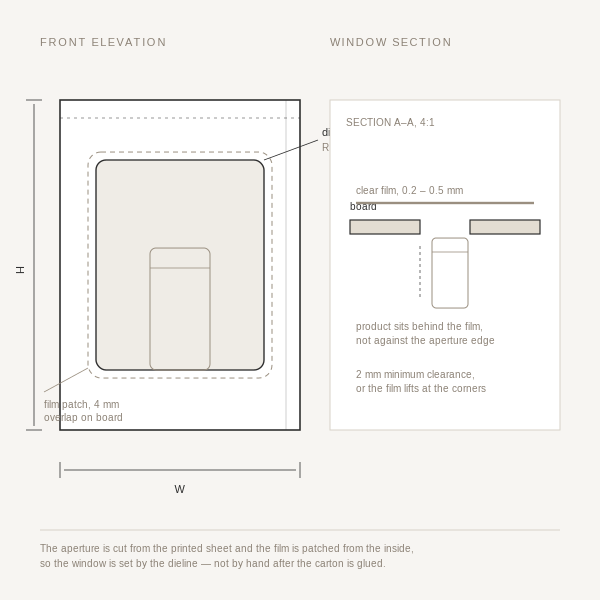
A window is a hole cut from a printed panel, which makes it a structural decision before it is a design one. The first question is whether the aperture is covered. A film patch — usually PET, glued from the inside with a 4 to 6 mm overlap onto the board — keeps dust out and stops a customer lifting a lid to touch the product. An open aperture costs less and is correct where the product is already wrapped, or where the film would only add a layer that nobody separates before recycling.
The second question is where the hole goes, and that is where window boxes fail. An aperture takes out the stiffest part of a panel: a window on the front of a shipping case can halve its compression strength, while a window in the lid of a rigid box leaves all four walls carrying the load. Every aperture also needs a margin from the score — 12 to 15 mm is the working figure — because board bows around a window cut close to a fold, and a bowed panel is how a film patch starts lifting at its corners.
A printed photograph of a serum or a truffle is a claim. The product behind a window is the thing itself, and on a crowded shelf that is a different kind of selling.
A window with a film patch lets a customer see without opening, which keeps the pack intact — and it shows immediately if the pack has been opened and reclosed.
Multipacks, sampler sets and retail-ready cases sometimes have to show what is inside. A window satisfies that without extra print or a second label.
One large aperture can carry less print than a full-face product photograph, which lowers the print cost of a short run and removes the problem of a colour proof that never matches the product.
A serum bottle, a compact or a set behind a film-patched window on a retail shelf, where the pack must be visible and still arrive untouched.
An aperture over a single layer, with the film keeping the surface clean — and the film declared as a food-contact layer, because in this application it is the layer that touches the food.
An open aperture, or a paper window in glassine, for a product that is already sealed inside its own pouch or wrapper.
A window cut into the lid of a rigid box, so a gift set reads as a set before it is opened, with the walls of the box still carrying the stack.
A window is a cut line in a printed sheet. It is either in register with the print or it is not, and the difference shows as a border that is 6 mm on one side and 9 mm on the other.
Where the window sits inside a printed frame, the frame and the cut have to be in the same pass or in a register the press can hold. A frame drawn to sit 8 mm from the aperture means 8 mm ±0.5 mm; a frame drawn by eye means the border is visibly uneven on the first box and on every box after it.
Customise this boxA PET patch is a plastic layer bonded to a paper box, and it ends the "plastic-free" claim for the whole pack unless the customer tears it out — most do not. Where the claim matters, the answers are a paper window in glassine or vellum, an open aperture, or a compostable film that is certified for the market it sells in.
Customise this boxNot on the face that carries the load in a stack, not within 12 mm of a score, not across a glue seam, and not on the base of a shipper. Each of those turns a cosmetic feature into a failure: a crushed panel, a lifted patch, a seam that opens, a box that lands on its weakest face.
Customise this boxThe border around the aperture is the cheapest way to make a window look deliberate, and it is also the finish most sensitive to register.
Keeps fingerprints off a pack that is handled on a shelf. It also wraps the whole carton in plastic film, which matters if the pack is sold as recyclable.
A foil line around the window reads as premium and hides a slightly uneven cut, because the eye follows the metal rather than the aperture edge.
Gloss on the frame against a matte field, used to draw the eye to the window rather than to the brand mark.
A shallow emboss on the frame, kept back from the cut — a relief that runs into the aperture tears the board at the corner.
A printed inner face is what a customer sees through an open aperture, so the inside of the box is part of the design rather than raw board.
| Structure | Folding carton, corrugated mailer, or rigid box with a window lid |
|---|---|
| Board | Carton board 300 – 400 gsm; E-flute; greyboard 1.5 – 2 mm for a rigid lid |
| Window shape | Rectangular R10 – R15, circular, or full-face |
| Window margin | 12 – 15 mm from every score and from any glue seam |
| Film | PET 0.2 – 0.5 mm; compostable film; glassine or vellum paper window |
| Printing | Offset CMYK or Pantone spot; digital for short runs |
| Finishing | Matte or gloss lamination, spot UV, foil, emboss |
| Food contact | Board and film declared separately where the window touches food |
| Minimum order | Typically from 500 pieces per size and specification; confirmed in your written quotation |
| Sample lead time | 4 – 6 working days from approved artwork |
Specifications are confirmed on your written quotation. Anything not written into the specification is not part of the order.
Wall grade and case construction are specified to GB/T 6543, the Chinese national standard for single- and double-wall corrugated shipping cases, which fixes the flute combinations, the box grades built from them, and the ±3 / ±5 mm dimensional tolerance on a finished case.
Board thickness is specified to ISO 534, the standard method for the thickness, density and specific volume of paper and board, so a millimetre in a specification means the same thing to both sides.
The board, print method and finish named above are explained in the packaging options reference — what each option does, which materials it works on, and where it stops working.
All of it is made in our two plants in Nanhai, Foshan, and Panyu, Guangzhou: Metapackink is the manufacturer rather than a broker, so the board is cut, the wrap printed and the box assembled on our own floors, where the sample comes from.
Everything else — minimum order, lead times, Incoterms, shipping — is the same whichever box you buy, and is set out under the table.
| OEM / ODM | We offer complete OEM and ODM for window boxes. ODM means putting an aperture into a carton we already make; OEM means developing the dieline, the window shape and the film patching from the product and the way it is displayed. |
|---|---|
| Checked on the sample | A window sample is approved loaded and on a shelf, because a film patch that looks flat on a bench shows its lift once the board takes up the product weight behind it. |
| Warranty | Window boxes are warranted against the approved sample for aperture position, register of the printed frame, film adhesion and panel flatness. |
Minimum order quantities are generally based on box size, structure and specifications. Standard custom orders typically start at 500 pieces per size and specification. Available stock sizes, simpler structures and repeat orders may allow lower quantities; special materials, complex structures and custom inserts may require higher minimums. Your written quotation confirms the minimum for your specification. Samples take 4 – 6 working days from approved artwork. Sample lead time is a separate stage from production; courier time is additional. Production takes 10 working days from the later of receipt of the cleared deposit or written sample approval. Transit time is additional. Shipping terms: EXW, FOB, CIF or DDP, sea, air or courier. Sequence and inspection: process · quality control.
A printed box with an aperture cut through a panel so the product is visible without opening it. The window can be open, or covered by a clear film patch glued to the inside of the board.
Cover it when the product must not be touched or dusted on a shelf, or when the pack has to stay sealed. Leave it open when the product is already wrapped — tea in a pouch, chocolate in a foil — because then the film adds a layer that has to be separated before recycling and does no work.
Yes on the panel that carries it, and the fix is a board grade up plus a proper margin from the scores. A window in the lid of a rigid box is the mild case, because the walls still carry the stack; a window in the face of a shipping case is the bad one.
Yes, with a paper window in glassine or vellum, or with no film at all. A PET patch is a plastic layer bonded to a paper box, and in most packs it is not removed by the customer, so a plastic-free claim does not survive it.
Yes. The aperture is cut in the wrapped lid and a board ring is glued inside it, which keeps the panel flat and gives the film something to sit against. It costs more than a carton window because the lid is hand-wrapped.
Shape, insert and industry change what window boxes can do without changing the structure underneath. Board and finishing are shared across the factory.
Finishing and board options are shared across the factory — how each is applied is on the manufacturing process page, and the structures they can be built into are on packaging solutions.
Commonly bought for Beauty and skincare Retail and branded Gift and presentation