The unboxing is the point
Brands where opening the package is a designed experience the customer films, photographs or repeats.
Custom magnetic boxes: concealed magnets in the lid and the base hold a rigid shell shut. The box opens deliberately rather than falling open.
| Quantity | Unit price |
|---|---|
| 500 pcs | $2.00 – $5.00 |
| 1,000 pcs | $1.50 – $4.00 |
| 5,000 pcs | $1.00 – $2.80 |
Prices are indicative reference unit prices per box in USD, based on the stated order quantities. Actual pricing depends on box dimensions, materials, printing, finishing, inserts, order specifications and shipping terms. Final prices are confirmed through a written quotation.
Reference prices reviewed
Metapackink is a custom magnetic box manufacturer based in Guangzhou, China. The company offers custom magnetic boxes, with customization options for dimensions, materials, printing and finishing. MOQ depends on box dimensions, construction, insert requirements and customization. Standard custom orders typically start at 500 pieces. Available stock sizes, simpler structures and repeat orders may allow lower quantities; special materials, complex structures and custom inserts may require higher minimums. Your written quotation confirms the minimum for your specification.
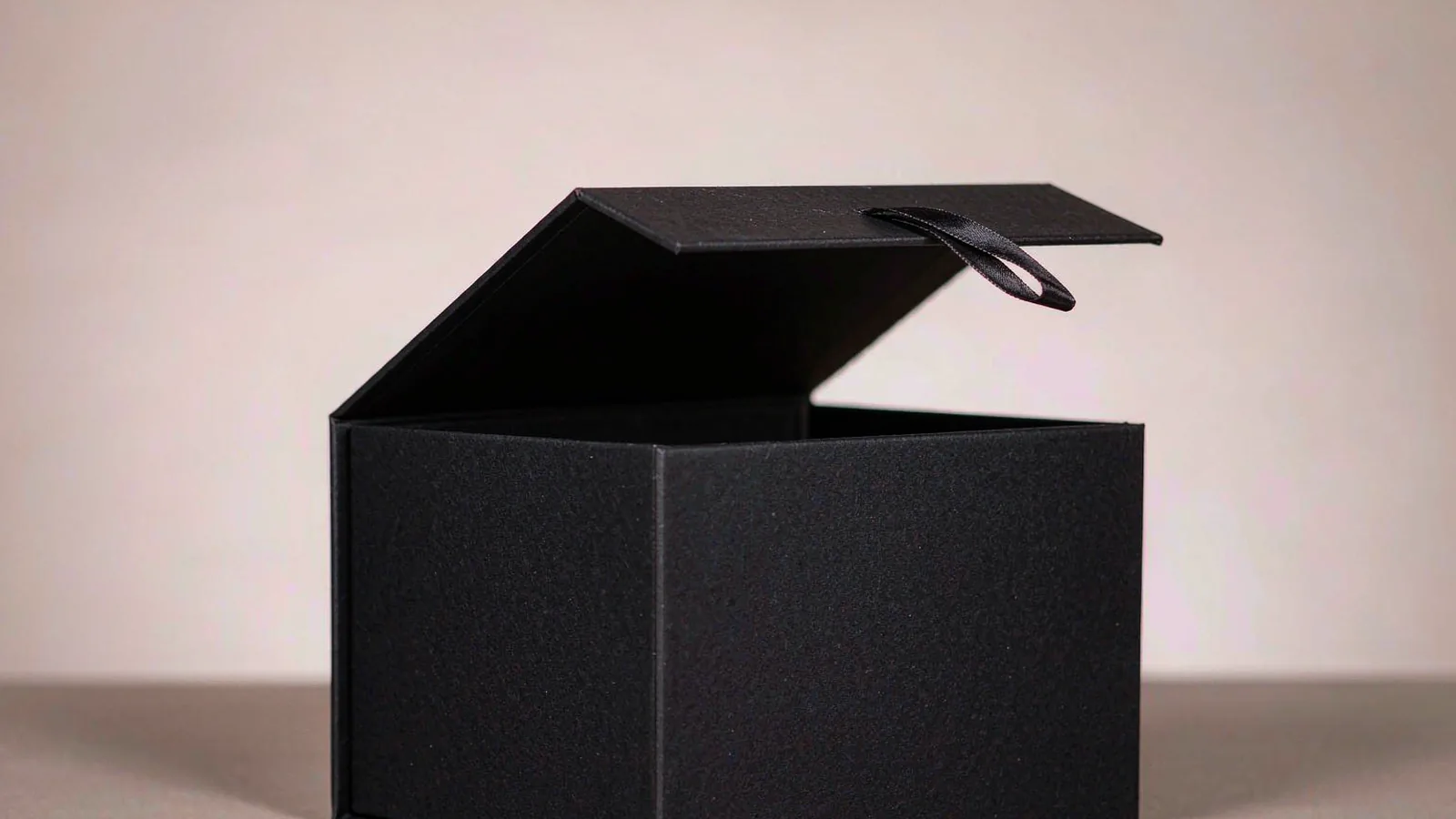

A magnetic closure box is a rigid box with magnets set into the lid and the base so the lid snaps down and holds. The magnets are concealed inside the board, so nothing is visible from the outside — the closure simply feels intentional, and the box stays shut in a bag or on a shelf.
It is the structure most often chosen for unboxing-led products and gift sets, because the moment of opening is a designed moment rather than an accident of gravity.
This page is about the structure itself: the closure, the board, the wrap and the opening. A box specified around what goes inside — a flacon, a compact, a gift set — or around where it is sold is a different set of decisions, and each of those has its own page, linked below.
MOQ depends on box dimensions, construction, insert requirements and customization. Standard custom orders typically start at 500 pieces. Available stock sizes, simpler structures and repeat orders may allow lower quantities; special materials, complex structures and custom inserts may require higher minimums. Your written quotation confirms the minimum for your specification.
A printed and wrapped box has one setup. A box that is printed, laminated, foiled, embossed and die-cut has five, and each one is paid once whether the run is 500 or 5,000. Bought components — magnets, ribbon, a moulded tray — arrive with a minimum lot of their own, and hand work never amortises: twice the boxes is twice the wrapping.
The closure adds a component that has to be bought in and set by hand. Magnets and steel plates come in their own lots with their own minimums, they are set into recesses so the wrap stays flat, and the two halves have to register when the lid closes. None of that work shrinks at low quantity — it is the same setting-up for 300 boxes as for 3,000, which is why the closure is a larger share of the unit price at low hundreds than it is at volume.
Brands where opening the package is a designed experience the customer films, photographs or repeats.
The magnetic lid keeps the box shut in a bag, and the rigid structure survives being kept and reused.
Presentation sets, beauty sets and subscription boxes where the rigid shell and the closure are part of what the customer keeps.
Products handled or displayed by the customer, where a loose lid would open at the wrong moment.
Gift sets that are opened and closed repeatedly, where the closure has to keep its feel.
Limited runs where the box is the launch and the closure is part of the reveal.
Cables, chargers and small devices presented rather than simply packed.
Client gifts and awards where the lid has to open flat and stay flat.
A magnetic box is a rigid box with a neodymium or ferrite magnet set into the wrap at the lid edge, so the closure is the feature. The magnet strength (usually 0.5 to 1.5 kg pull for a small box) is matched to the lid weight and how the box is opened; a heavier lid or a thicker wrap needs a stronger magnet seated deeper in the board.
Choose the placement from how the box is used. A lid that lifts straight up wants the magnet on the front edge; a flap that folds over wants it at the flap tip; a book-style that opens like a book wants it along the spine edge. The magnet is set into a routed pocket in the board so it sits flush and does not print a bump through the wrap.
The check is the lid shutting in your hand, not the spec sheet. If the lid drifts open under its own weight the magnet is too weak or too far from its mate; if the wrap shows a bump the pocket is too shallow. Every magnet is confirmed on a physical sample with the lid opened and closed, and written into the quotation.
The three closures share a rigid shell but not an unboxing. A magnetic box closes with a click and reopens in one motion — the premium, repeat-use feel. A ribbon box ties shut and reads as gift, but the knot is manual and slower to pack. A ribbon-and-slip (ribbon pulls a tray out of a sleeve) adds theatre but more parts and more hand work.
In practice the magnetic box is the one chosen for a product that is opened and closed repeatedly — a phone, a watch, a perfume that lives on a dresser; the ribbon box is the gift presentation; the slip is the launch or limited edition. The factory recommends the closure from how many times the box is opened, not from trend.
We do not present one as simply better. On the quotation the choice follows the use: a daily-use box almost always goes magnetic, a one-time gift almost always goes ribbon. The trade-off in feel, packing speed and cost is on the magnetic box guide linked from this page.
A magnetic box is specified by the inner size plus the board and the lid overlay — the depth the lid covers down the base. Inner length = product length plus 3–5 mm; the same for width and height; add twice the board thickness (1.5 to 3 mm) to reach the base outer size; the lid overlay is then set at 12–20 mm so the magnet seats on the front face and the lid hides the base edge.
Work it from the product outward. A 60 × 40 × 25 mm item needs an inner 66 × 46 × 31 mm; with 2 mm board the base outer is about 70 × 50 × 35 mm, and a 15 mm overlay makes the lid 50 mm tall at the front. The magnet pocket is cut into the lid board at that overlay line, so the overlay also sets where the magnet sits.
Two things the sample room checks that the arithmetic misses. The magnet in the lid must meet the steel or magnet in the base with no gap, so the overlay and the pocket depth are checked together; and the lid must not bind on the base corner. Every dimension and magnet seat is confirmed on a physical box, never taken from a stock size list.
A magnetic box quotation adds the magnet line to the usual rigid box costs. Board grade and thickness lead; then the magnet itself — neodymium costs more than ferrite and a stronger pull costs more than a weak one; the routing pocket is a small extra operation. The construction, print colours and finishing (foil, emboss, soft-touch) each add a line, and an insert adds another.
Two lines move with volume and timing. The minimum is 500 pieces, and tooling amortises across the run, so a 2,000-piece order is cheaper per unit than 500; the sample is charged at US$30 to 120 with a 4 to 6 working-day lead, credited against the production order where the quotation says so. The last line is packing and freight: carton count, dimensions, weight and the Incoterm — under FOB you arrange the main carriage, under DDP you receive one landed cost.
The honest comparison is landed cost, not the box price alone. A lower box price with a larger shipping cube can cost more by the time it arrives, so we ask buyers to compare suppliers on the figure that reaches their warehouse, not the ex-works number. Anything not written into the specification is not part of the order.
A magnetic box lives or dies on its closure. Magnet grade, count and position are chosen together against the lid size and the way the box is carried, and the result is proved on a physical sample rather than on a drawing.
Too weak and the lid drifts open when the box is carried by the base. Too strong and the customer has to pry it open, which is a worse first impression than a loose lid. Grade and count are specified against the lid dimensions and the holding force the box needs, which is why lid size matters more here than product weight does.
Customise this boxMagnets sit in recesses between the board and the wrap, so nothing shows from outside and no bulge telegraphs through a soft-touch laminate. Placement is set in the dieline so every box in the run seats at the same height, not just the sample that was photographed.
Customise this boxA ribbon pull, a die-cut thumb tab, or a lift-off lid with no tab at all. A ribbon can be colour-matched to the palette and anchored under the wrap; a thumb tab interrupts the outer face but needs no extra component. Whichever you choose decides how the first two seconds of the unboxing feel.
Customise this boxBrand mark or logo in metallic or specialty foil on the lid face or the spine.
Tactile branding that reads in the hand as well as the eye.
Gloss pattern against matte for a layered, premium surface.
A velvety surface finish that is common on premium beauty and fragrance packaging.
Full-colour printed paper or specialty textured stock with your artwork.
Satin or grosgrain ribbon pull, colour-matched to the brand palette.
| Decision | This box suits you if | This box does not suit you if |
|---|---|---|
| Order quantity | You can commit 500 pieces to one size. The closure is where a small run costs most. | You need 200 pieces as a test, or several sizes in the low hundreds. |
| Product | A gift set, a launch edition, a fragrance or skincare box that is kept rather than discarded. | A cost-led retail line where the box is opened once and thrown away. |
| The reveal | The unboxing is part of the product: a lid that lifts and snaps shut on a magnet. | The box ships direct to the customer by post, and weight is the largest line in its cost. |
| Structure | Rigid box with concealed magnetic closure, full or half flap |
|---|---|
| Colour | Any Pantone, CMYK or metallic shade on the wrap; matched to the approved sample under standard lighting |
| Printing | Offset CMYK or Pantone spot colour, with foil, emboss, deboss or spot UV over it |
| Board | Greyboard 1.5 mm – 3 mm |
| Magnet | Size and grade specified against lid dimensions and required holding force |
| Magnet placement | Concealed between board and wrap, recessed so the surface stays flat |
| Opening | Ribbon pull, die-cut thumb tab, or lift-off with no tab |
| Wrap materials | Coated paper, specialty and textured paper, fabric, printed paper |
| Internal fitment | Die-cut paperboard, foam or EVA cavity, compartmented tray |
| Finishing | Foil, emboss, deboss, spot UV, lamination, screen print |
| Tolerance | Die-cut panels to ISO 2768-1 class m: ±0.2 mm up to 30 mm, ±0.3 mm up to 120 mm. An assembled box carries a wider allowance, because the wrap is applied by hand. |
| Assembled size | Finished outer dimensions ±0.8 mm, measured across the lid once the wrap has settled |
| Smallest box | L 80 × W 50 × H 15 mm formed. |
| Print sheet | Sheet-fed offset up to 1,100 × 1,600 mm; flexo up to 1,397 × 2,413 mm |
Specifications are confirmed on your written quotation. Anything not written into the specification is not part of the order.
Board thickness is specified to ISO 534, the standard method for the thickness, density and specific volume of paper and board, so a millimetre in a specification means the same thing to both sides.
Colour is controlled to ISO 12647-2, offset process control, measured against a physical Pantone reference rather than a screen.
The board, print method and finish named above are explained in the packaging options reference — what each option does, which materials it works on, and where it stops working.
All of it is made in our two plants in Nanhai, Foshan, and Panyu, Guangzhou: Metapackink is the manufacturer rather than a broker, so the board is cut, the wrap printed and the box assembled on our own floors, where the sample comes from.
Everything else — minimum order, lead times, Incoterms, shipping — is the same whichever box you buy, and is set out under the table.
| OEM / ODM | We offer complete OEM and ODM services for magnetic closure boxes. ODM means adapting one of our existing magnetic structures and magnet positions to your lid; OEM means specifying the closure from your drawing. |
|---|---|
| Checked on the sample | A magnetic sample is approved loaded and closed, then inverted and carried by the base — a magnet that holds convincingly on a bench can still lift at the front corners in a bag. |
| Warranty | Magnetic closures are warranted against the approved sample for holding force and lid alignment after repeated opening, the two faults that only surface once the customer has the box. |
MOQ depends on box dimensions, construction, insert requirements and customization. Standard custom orders typically start at 500 pieces. Available stock sizes, simpler structures and repeat orders may allow lower quantities; special materials, complex structures and custom inserts may require higher minimums. Your written quotation confirms the minimum for your specification. Samples take 4 – 6 working days from approved artwork. Sample lead time is a separate stage from production; courier time is additional. Production takes 10 working days from the later of receipt of the cleared deposit or written sample approval. Transit time is additional. Shipping terms: EXW, FOB, CIF or DDP, sea, air or courier. Sequence and inspection: process · quality control.
Strong enough to hold the lid closed in handling, but not so strong that the customer has to pry it open. Magnet size and grade are specified against the lid dimensions and the holding force the box needs, which is why lid size matters more than the product weight here.
Yes, and they normally are. The magnets sit in recesses between the board and the wrap so the outside of the box stays perfectly flat with no bulge or visible closure.
A two-piece box is a separate lid and base held by friction and gravity; a magnetic box has a hinged lid held by magnets. Magnetic boxes cost more, open more deliberately, and stay shut in transit. See the comparison for the full trade-off.
Yes. A colour-matched satin or grosgrain ribbon pull is one of the most common additions, either as a lift tab or as a decorative band under the lid.
The rigid shell and the board hinge are what keep alignment. We build the hinge and lid clearance so the box still closes cleanly after repeated use, which matters for packaging that is kept rather than discarded.
The box is not the parcel. A 1.5 – 3 mm greyboard shell is specified against the span of the lid, and it keeps its shape inside a mailer — but whether a rigid gift box can travel as the parcel itself is settled by a transit test, not by the board grade alone. We test the packed parcel to ISTA 1A when a job calls for it, and the board is confirmed on the sample with your product inside.
The magnets were sized for a smaller or lighter lid. Closure pull has to be specified against the lid overhang and the weight of the loaded box rather than copied from a previous job: a larger lid needs either more magnets or a stronger grade, or its corners lift when the box is carried by the base. Concealed magnets sit under the wrap, so grade and count are what a buyer specifies; magnet diameter alone is not a pull force. Load the sample with the real product, close it and carry it by the base before approving.
A moulded insert needs wall thickness to hold its own shape, and that thickness is subtracted from the usable interior. The bottles have not changed; the cavity around each one has grown, so the outer box has to grow with it. A die-cut paperboard insert is thinner, but with several glass bottles it needs a folded rib between each pair to stop them touching, and the folded assembly can consume more clearance than the moulded insert. Decide the insert before the box dimensions are fixed rather than after: the difference appears again in the carton count and on the pallet.
Shape, insert and industry change what magnetic closure boxes can do without changing the structure underneath. Board and finishing are shared across the factory.
Finishing and board options are shared across the factory — how each is applied is on the manufacturing process page, and the structures they can be built into are on packaging solutions.
Commonly bought for Cosmetics and skincare Gifting and presentation Premium consumer products