Bottle footprint and height
Including any cap or atomiser that is wider than the bottle body, which is the most common fit error we correct.
Perfume packaging is the box and fitment built around a bottle; compare the structures — rigid, magnetic or drawer — then build the chosen one around yours. Specific types have their own pages (magnetic, luxury, manufacturer); this page is the structure overview and links to the fragrance-sector view.
| Quantity | Unit price |
|---|---|
| 500 pcs | $0.50 – $2.50 |
| 1,000 pcs | $0.35 – $1.80 |
| 5,000 pcs | $0.20 – $1.20 |
Prices are indicative reference unit prices per box in USD, based on the stated order quantities. Actual pricing depends on box dimensions, materials, printing, finishing, inserts, order specifications and shipping terms. Final prices are confirmed through a written quotation.
Reference prices reviewed
Metapackink is a custom perfume packaging manufacturer based in Guangzhou, China. The company offers custom perfume packaging, with customization options for dimensions, materials, printing and finishing. Minimum order quantities are generally based on box size, structure and specifications. Standard custom orders typically start at 500 pieces per size and specification. Available stock sizes, simpler structures and repeat orders may allow lower quantities; special materials, complex structures and custom inserts may require higher minimums. Your written quotation confirms the minimum for your specification.
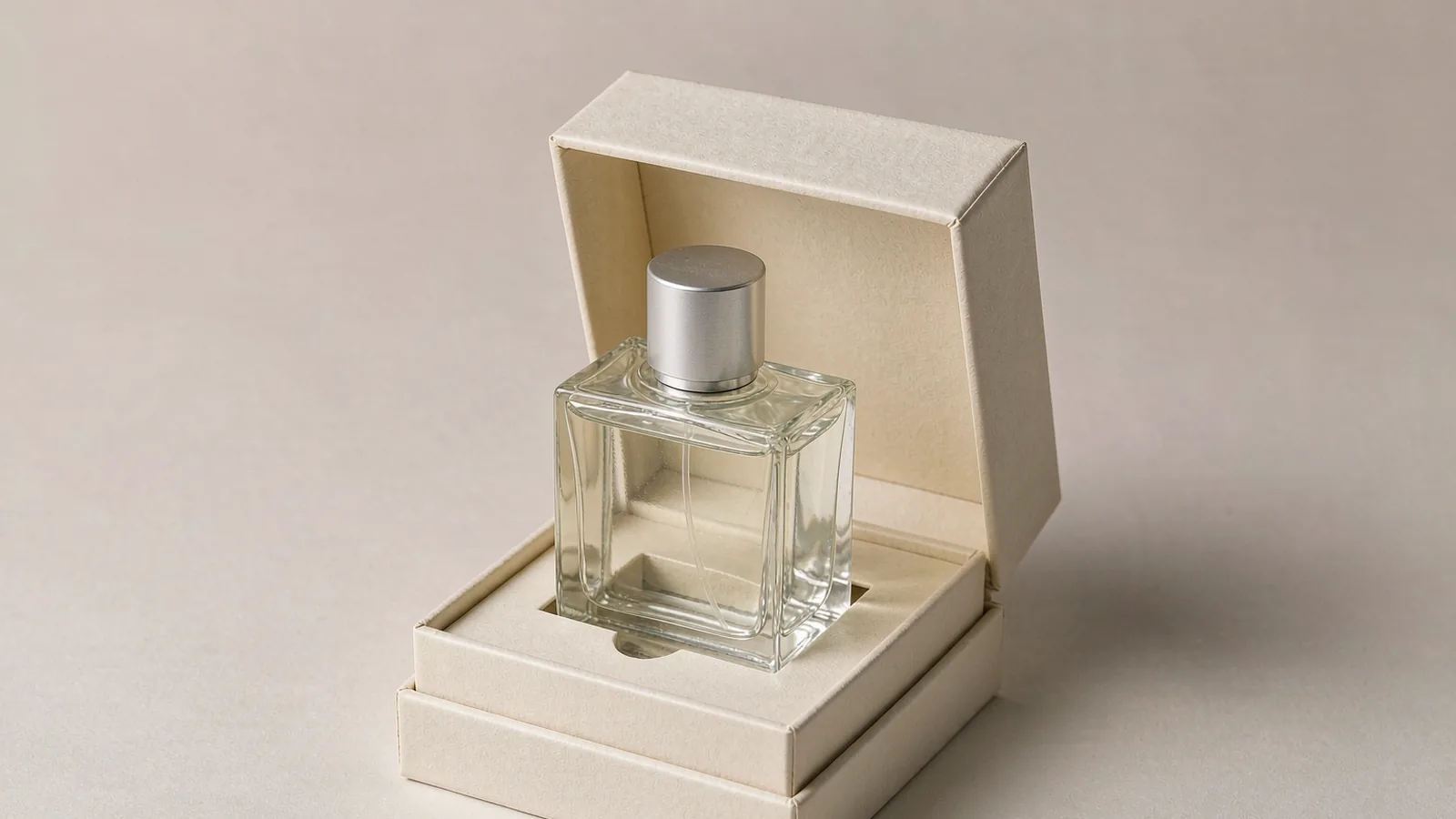

Perfume packaging is a dimensional problem before it is a design problem. The bottle has a specific footprint and height, the cap is often wider than the body, and the whole thing has to arrive without moving inside the box. Get the cavity wrong and no amount of finishing rescues it.
So we work from the bottle. Send the bottle dimensions — or the bottle itself — and the box and insert are developed around it, with the clearance set so the bottle is held firmly but can be taken out without force.
Including any cap or atomiser that is wider than the bottle body, which is the most common fit error we correct.
Glass is heavy per unit volume; the board thickness and cavity depth follow the weight, not just the dimensions.
Set so the bottle cannot rattle in transit but still lifts out cleanly. Too tight is worse than too loose — it risks chipping the glass.
Single bottle, bottle plus a smaller travel size, or a full set with a printed insert card.
Single bottles from 30 ml to 200 ml, sized against the glass rather than a stock box.
A bottle with a miniature or a body product, held in one cavity at one height.
Several vials presented together, where the fitment is the whole design.
Short runs where the structure carries the launch and is not repeated.
Perfume packaging is a dimensional problem before it is a design problem. The bottle has a footprint and a height, the cap is often wider than the body, and the whole thing has to arrive without moving. Get the cavity wrong and no amount of finishing rescues it.
Overall height with the cap on, body width and depth, the widest point if the shoulders or the cap exceed the body, and the filled weight. A cap wider than the body is the single most common cause of a fragrance box that will not close, and it is invisible in a dimension list that only quotes the bottle itself.
Customise this boxGlass is heavy per unit of volume, so board thickness and cavity depth follow the weight rather than the outline. Clearance is set so the bottle cannot rattle in transit but still lifts out cleanly. Too tight is the worse error here, because a tight cavity chips the glass at the shoulder.
Customise this boxFoil carries fine detail on a small panel better than process print does, and it is what the category expects to see. Soft-touch lamination gives the matte, velvety surface the hand reads as expensive. Where the two meet on one panel the foil is applied first, and the interaction is checked on the sample.
Customise this boxThe dominant finish on fragrance packaging — brand marks, borders and fine detail in metallic or specialty foil.
Tactile brand marks, often combined with foil on the same element.
A velvety matte surface that is standard across premium fragrance.
Gloss detail layered over a matte, soft-touch surface.
Heavy textured stock for a tactile surface under the hand.
Colour-matched satin ribbon as a pull or as a decorative band.
| Structures | Rigid lid-and-base, magnetic closure, drawer |
|---|---|
| Colour | Any Pantone, CMYK or metallic shade; metallised and pearlescent boards available |
| Printing | Offset CMYK or Pantone spot colour, with foil, emboss, deboss or spot UV over it |
| Bottle sizes | From travel-size 10 ml up to large-format flacons |
| Board | Greyboard 1.5 mm – 3 mm, specified against bottle weight |
| Fitment | Die-cut paperboard collar, foam or EVA cavity, moulded insert |
| Neck support | Available where a tall bottle needs the cap restrained |
| Wrap materials | Coated paper, specialty and textured paper, fabric, printed paper |
| Finishing | Foil, emboss, deboss, spot UV, soft-touch lamination, screen print |
| Tolerance | Die-cut panels to ISO 2768-1 class m: ±0.2 mm up to 30 mm, ±0.3 mm up to 120 mm. An assembled box carries a wider allowance, because the wrap is applied by hand. |
| Assembled size | Finished outer dimensions ±0.8 mm, measured across the lid once the wrap has settled |
| Smallest box | L 80 × W 50 × H 15 mm formed. |
| Print sheet | Sheet-fed offset up to 1,100 × 1,600 mm; flexo up to 1,397 × 2,413 mm |
Specifications are confirmed on your written quotation. Anything not written into the specification is not part of the order.
Board thickness is specified to ISO 534, the standard method for the thickness, density and specific volume of paper and board, so a millimetre in a specification means the same thing to both sides.
Colour is controlled to ISO 12647-2, offset process control, measured against a physical Pantone reference rather than a screen.
The board, print method and finish named above are explained in the packaging options reference — what each option does, which materials it works on, and where it stops working.
All of it is made in our two plants in Nanhai, Foshan, and Panyu, Guangzhou: Metapackink is the manufacturer rather than a broker, so the board is cut, the wrap printed and the box assembled on our own floors, where the sample comes from.
Everything else — minimum order, lead times, Incoterms, shipping — is the same whichever box you buy, and is set out under the table.
| OEM / ODM | We offer complete OEM and ODM services for fragrance packaging. ODM means fitting an existing fragrance structure to your flacon; OEM means developing the cavity and the cradle from your bottle. |
|---|---|
| Checked on the sample | A fragrance sample is produced and checked with the actual bottle fitted, filled to its working weight, so the cavity is proved with glass in it rather than empty. |
| Warranty | Fragrance packaging is warranted against the approved sample with the bottle fitted, covering cavity clearance and cap support, which is where a fit problem shows up first. |
Minimum order quantities are generally based on box size, structure and specifications. Standard custom orders typically start at 500 pieces per size and specification. Available stock sizes, simpler structures and repeat orders may allow lower quantities; special materials, complex structures and custom inserts may require higher minimums. Your written quotation confirms the minimum for your specification. Samples take 4 – 6 working days from approved artwork. Sample lead time is a separate stage from production; courier time is additional. Production takes 10 working days from the later of receipt of the cleared deposit or written sample approval. Transit time is additional. Shipping terms: EXW, FOB, CIF or DDP, sea, air or courier. Sequence and inspection: process · quality control.
Overall height including the cap, the bottle body width and depth, the widest point if the cap or shoulders are wider than the body, and the filled weight. If the cap is wider than the bottle body, tell us — that is the most common cause of a box that does not close properly.
Yes, and it is the most reliable route. Send the physical bottle or a filled sample and the cavity is developed and tested against it, so the fit is confirmed before production rather than discovered afterwards.
Normally a die-cut paperboard collar that grips the bottle at the base, sometimes with a neck or cap support for tall bottles. Foam and EVA cavities are used where the bottle shape is irregular or the protection requirement is higher.
Not if the cavity is specified correctly. Clearance is set tight enough to hold the bottle firmly without making it difficult to remove — the tension is checked on the physical sample with the actual bottle fitted.
Yes. Compartmented fitments for a full-size bottle plus a travel size, or a complete set with a printed insert card, are common configurations.
Let the foot of the bottle carry the weight, and let everything above it only locate the bottle.
Glass is strongest in compression through the thick section at the foot and weakest at the neck, where the thread concentrates stress. A die-cut board disc with an aperture larger than the cap and smaller than the body catches the shoulder while the foot rests on the base panel; a foam or EVA silhouette that grips the whole height can hang the bottle from its shoulder, which is what cracks in a drop test. Leave clearance above the cap so the lid panel can deflect on impact. Load the filled bottle, close the lid, turn the box upside down and carry it by the base before approving the sample.
The shipping carton. It is what the parcel network or the container handles, while the gift box inside is not a structural member: its job in transit is to stay square and unmarked. A test on the outer carton records the faces, edges and corners that take the impact and shows which layer failed when something breaks. Ask for the standard and the sample description in the report, and check that they match the substrate and packing you are actually buying: a report for a different carton count or a different board grade is not evidence about your order.
Shape, insert and industry change what perfume packaging can do without changing the structure underneath. Board and finishing are shared across the factory.
Finishing and board options are shared across the factory — how each is applied is on the manufacturing process page, and the structures they can be built into are on packaging solutions.
Commonly bought for Fragrance Premium consumer products