COSMETICS & BEAUTY

Custom cosmetic packaging for beauty brands

Cosmetic packaging is the box or set that carries skincare, makeup and personal-care products, developed around the bottle it holds, the shelf it sits on and the journey it has to survive before either.

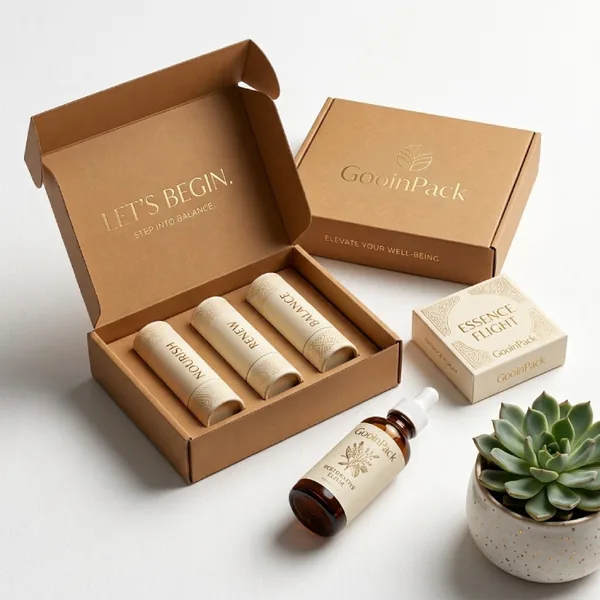
An open kraft corrugated mailer printed inside with three rolled kraft items, beside a closed mailer and a small printed carton

Cosmetic packaging is judged twice, and the two judgements pull in opposite directions. On a shelf or in a photograph it has to sell a product in the second or two of attention it gets — which pushes towards a sparse surface, a strong finish and a clean face. In transit it has to survive being shipped as a parcel, which pushes towards structure, fitment and protection.

The difficulty is mostly in the second half. A cosmetic box usually contains something that leaks, something with a component that can crack, or several items that have to arrive still sitting in their own compartments. That is what the structure is actually solving, and it is why a cosmetic box is rarely just a gift box with different artwork.

Related reading: Peptide ampoule boxes with a pocket for each single dose, Drawer cosmetic boxes revealed by a ribbon pull.

What is genuinely difficult about cosmetic packaging

These are the problems that decide the specification. Presentation questions come after them, not before.

Leaking and residue migration

A pump or dropper bottle can weep a small amount of product. That residue wicks into uncoated board and shows as a stain on the outside of the box within weeks. Where the product is oil-based or alcohol-based, the board has to be faced with a barrier rather than left raw.

Every SKU is a different shape

A 30 ml dropper, a 50 ml pump jar and a compact are three different solids with three different centres of gravity. A fitment cut for one will not hold the others. Packaging a range usually means either separate fitments per shape or one layout that locates each container by its own edge.

Travel and humidity

Beauty products travel as check-in luggage and sit in steamy bathrooms. Humidity softens board, and soft board lets a fitment loosen so the bottle moves and the cap takes the impact. Rigid construction plus a tight cavity is what prevents it.

Component damage before the box is opened

Caps, atomisers, droppers and mirrors crack rather than dent. This is a clearance problem: the cavity has to hold the container so the fragile part cannot move, without pressing on it hard enough to stress the closure.

Multi-piece sets that must stay separate

A routine set of four items has to arrive as four items in four positions, not as one rattling mass. That is a compartmented tray with defined pockets, and it has to survive the box being turned over.

A surface that photographs well

Beauty packaging is shot constantly — for product pages, for influencers, for social. A finish that catches fingerprints, scuffs at a touch or reflects the camera reads as cheap on a phone screen even when the print is correct.

Fitments, by container type

ContainerWhat the fitment has to do
Dropper bottlesLocate on the body, not the cap. The dropper bulb is the most crushable part of the whole package and should never carry the load.
Pump and mist spraysLeave the actuator clear of the fitment wall, so nothing depresses it in transit and empties the product into the box.
Jars and creamsSupport on the shoulder, and account for the weight of the filled jar rather than the empty one.
Compacts and palettesHold flat and prevent the hinge from cycling open; usually a recessed ledge rather than a full cavity.
TubesShort tubes tend to roll. They need a flat channel or a shaped cradle, not a round hole.
Candle and fragrance vesselsAssume the glass is heavy and brittle, and cushion both ends since the base takes the drop.
Mirrors and applicatorsSit in their own slot away from anything hard, or the silvering scratches in transit.

Structures we build for cosmetic products

Rigid lid-and-base

The default for a single premium product, with a die-cut fitment locating the container. Highest perceived value for a single-item box.

Magnetic closure

For sets and gift ranges where the unboxing is photographed and the lid has to stay shut in a bag.

Two-piece rigid

A lidded box with a fitted base, used where the box is handled repeatedly and has to close cleanly every time.

Drawer or sleeve

Where the product should be revealed by pulling, common for compact collections and smaller items.

Book-style and folder

For palettes, flat compacts and mirrors, where the contents are presented as a spread rather than a cavity.

Compartmented set boxes

Traced trays dividing a multi-product routine into separate pockets, each sized to its own container.

Finishing and surface

Soft-touch lamination

The most-requested beauty surface, because it reads matte without looking unfinished. It does show fingerprints, so it suits products handled briefly.

Matte lamination

A hard-wearing matte that resists scuffing better than soft-touch and is the safer choice for a box that travels loose in a bag.

Foil stamping

Metallic and coloured foil for branding and borders. On cosmetics it is usually kept small so the face stays clean.

Embossing and debossing

Tactile branding that reads in a photograph under side light, and adds perceived weight without adding a colour.

Spot UV

Selective gloss on a matte field — a common way to make one element lift off the surface in a product shot.

Textured and specialty stock

Linen, felt and uncoated boards give a surface that photographs as material rather than as print.

StructuresRigid lid-and-base, magnetic closure, two-piece rigid, drawer, book-style, compartmented set tray
BoardGreyboard 1.5 mm – 3 mm, specified against filled product weight
Wrap materialsCoated paper, specialty and textured stock, printed paper, fabric for premium ranges
Internal fitmentDie-cut paperboard, foam or EVA cavity, traced compartment tray, ribbon pull
Barrier optionsFaced or laminated interior where the product is oil- or alcohol-based
FinishingSoft-touch, matte or gloss lamination, foil, emboss, deboss, spot UV, screen print
Range consistencyOne structure and finish specification carried across a product family
SamplingPhysical sample for approval before every production run

Specifications are confirmed on your written quotation. Anything not written into the specification is not part of the order.

Board thickness is specified to⁠ ⁠ ISO 534,⁠ ⁠the standard method for the thickness, density and specific volume of paper and board, so a millimetre in a specification means the same thing to both sides.

Four to six weeks is normal for skincare packaging to reveal a residue problem. Board absorbs oil slowly, so a box that looks clean when it is first packed can be marked by the time a customer receives it. Where the product is oil-based, specify a faced interior from the start rather than substituting it after the first complaint.

Questions buyers ask about cosmetics and beauty

Can you package a whole skincare range consistently?

Yes, and it is usually the right approach. One board, one wrap and one finish specification applied across different box sizes keeps a range reading as one brand on a shelf. The fitments differ per container type; everything else stays constant. Send the full list of product dimensions and we will work through the range rather than one box at a time.

Will an oil-based product stain the box?

It can, if the interior is raw board. Oils and alcohols wick into uncoated paper and show through as a stain. Where that is a risk we face or laminate the interior, or set the product in a foam or tray that keeps liquid away from the board. Tell us the product type and we will specify accordingly.

Do you cut fitments for specific bottle shapes?

Yes — that is the normal starting point. Send the container dimensions including the cap, and we develop the fitment around the container body. For droppers and sprays we deliberately keep the fitment clear of the cap and actuator so nothing is stressed in transit.

Can a gift set hold items of different sizes?

Yes. A compartmented tray gives each item its own pocket sized to that item, so a set of four products arrives as four located pieces rather than as loose contents. The tray is cut to the specific combination, so send the full contents list.

Which finishes hold up best in transit?

Matte lamination is the most forgiving. Soft-touch feels better in the hand but marks more easily, so it suits boxes that are handled briefly and shown rather than carried loose. High-gloss film shows scuffs and fingerprints most clearly. If a box travels inside a bag or a suitcase, matte is usually the safer specification.

Do you supply folding cartons as well as rigid boxes?

Our production is built around rigid and paperboard constructions — rigid boxes, magnetic boxes, two-piece and drawer structures and the fitments inside them. If a folding carton is genuinely the right answer for a particular SKU we will say so rather than pushing everything towards a rigid box.

Tell us about your packaging project

Four required fields, with optional dimensions, project details and artwork attachments. The more of the optional detail you share — material, printing, finishing or insert requirements, reference images, a technical drawing, a destination country — the more specific our recommendation and quotation will be. Only the four required fields are marked with an asterisk.

Not sure? Choose “Not sure yet” and describe the product in the details box — we will recommend a structure.
Where the finished packaging is delivered. Freight and import duty depend on it.
AI, PDF, EPS, PSD, JPG, PNG or ZIP — up to 25 MB in total per enquiry.
PDF, AI, EPS, DXF, DWG or ZIP — a dieline or dimensioned drawing speeds up an exact quote.

We reply to every enquiry within two working days. Files are used only to prepare your quotation.

Since 200520+ years manufacturing packaging
two plantsFoshan & Guangzhou
ISO 900104626Q00932R001
AuditedMade-in-China.com · MIC-ASI261850