The product should be revealed
Jewellery, accessories, small premium goods, where sliding the drawer open presents the product cleanly.
Custom drawer boxes: elegant pull-out packaging for premium retail and gifting. An inner tray slides out of a rigid outer sleeve.
| Quantity | Unit price |
|---|---|
| 500 pcs | $1.50 – $4.50 |
| 1,000 pcs | $1.20 – $3.50 |
| 5,000 pcs | $0.80 – $2.50 |
Prices are indicative reference unit prices per box in USD, based on the stated order quantities. Actual pricing depends on box dimensions, materials, printing, finishing, inserts, order specifications and shipping terms. Final prices are confirmed through a written quotation.
Reference prices reviewed
Metapackink is a custom drawer box manufacturer based in Guangzhou, China. The company offers custom drawer boxes, with customization options for dimensions, materials, printing and finishing. Minimum order quantities are generally based on box size, structure and specifications. Standard custom orders typically start at 500 pieces per size and specification. Available stock sizes, simpler structures and repeat orders may allow lower quantities; special materials, complex structures and custom inserts may require higher minimums. Your written quotation confirms the minimum for your specification.
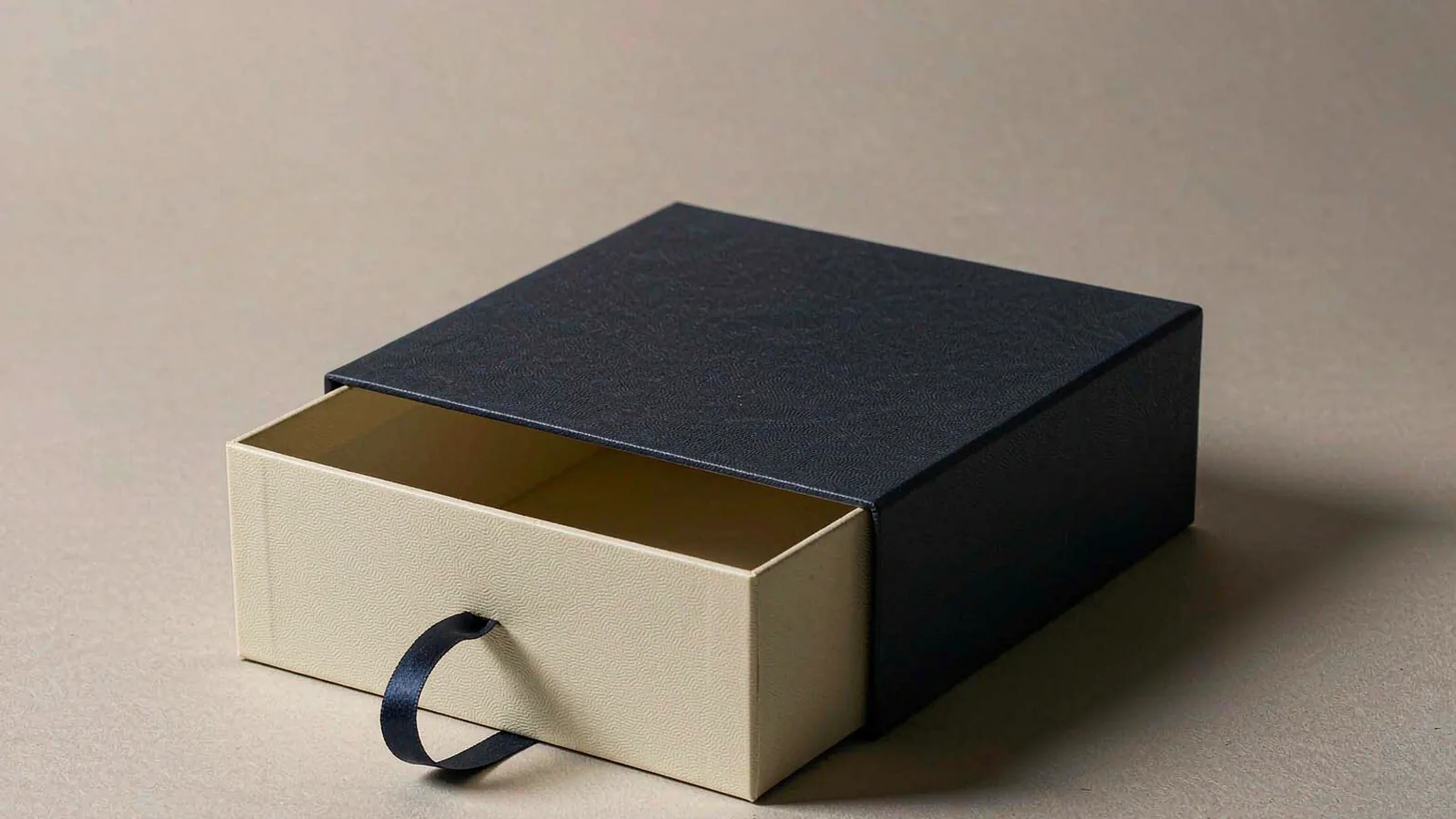
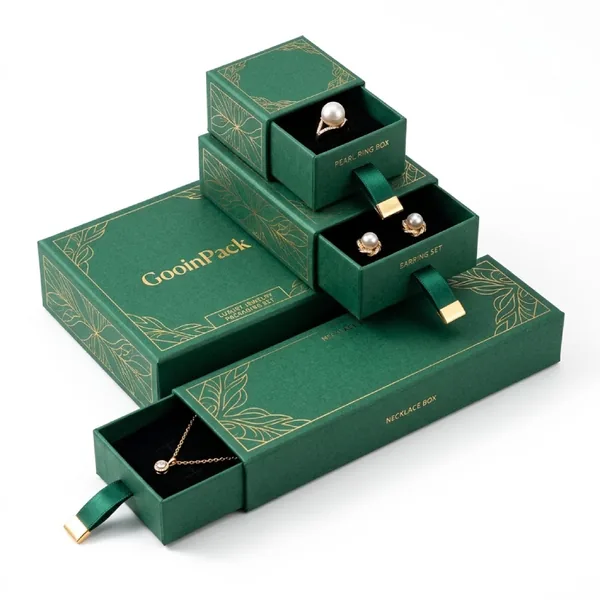
A drawer box is a rigid outer sleeve with a sliding inner tray. Pull the ribbon or the finger hole and the tray comes out, presenting the product as a revealed object rather than something lifted out of a lid.
The structure suits products that are displayed as much as they are opened, and it gives designers a clean, unbroken outer surface to print on — the sleeve can carry the artwork with nothing interrupting it.
Jewellery, accessories, small premium goods, where sliding the drawer open presents the product cleanly.
A seamless sleeve gives an uninterrupted printed or wrapped surface, with no lid seam or hinge to design around.
A drawer box stacks squarely and presents a clean face on shelf, which a hinged lid does not always do.
Drawer boxes are opened and closed often; the sliding action stays reliable where a friction lid loosens with use.
Single high-value items revealed by a pull rather than by lifting a lid off.
Repeated shipments where the sleeve stays branded and the tray changes.
Bottles and palettes seated in a cavity that presents them upright.
Flat products such as notebooks and cards that slide out rather than tip out.
A drawer box is a tray that slides into a sleeve, and the slide tolerance is the whole feel of the box. The tray is cut to sit inside the sleeve with 0.5–1.5 mm clearance per side — too tight and it jams, too loose and it rattles. The factory sets the tolerance from the board thickness and how often the drawer is opened.
Choose the tolerance from how the box is used. A drawer opened daily wants a slightly looser, smoother slide (1–1.5 mm); a presentation drawer opened once can run tighter (0.5–1 mm) for a snug, premium pull. A stop — a lip, a ribbon pull, or a notch — keeps the tray from sliding out, and its depth is set with the tolerance.
The check is the drawer in your hand, not the spec sheet. If it binds the clearance is too small or the sleeve is not square; if it rattles or falls out the clearance is too large or the stop is missing. Every drawer box is confirmed on a physical sample slid open and shut, and written into the quotation.
The two share a rigid shell but not an opening. A drawer box pulls a tray out of a sleeve — a horizontal, repeated-action unboxing. A shoulder-neck box lifts a lid off a neck that sits inside the base — a vertical reveal where the product rests on the shoulder. Different hand feel, different labour.
In practice the drawer is the one chosen for a product that is taken out and put back — tea, cards, tools, a daily cosmetic; the shoulder-neck is the luxury reveal for a hero product that is shown once. The factory recommends the format from the opening direction and how many times it opens, not from trend.
We do not present one as simply better. On the quotation the choice follows the use: a repeat-access product almost always goes drawer, a reveal product almost always goes shoulder-neck. The trade-off in make, feel and cost is on the drawer box guide linked from this page.
A drawer box is specified by the tray inner size, then the sleeve is built around it. Tray inner length = product length plus 3–5 mm; the same for width and height; add twice the tray board (1.5 to 3 mm) to get the tray outer. The sleeve inner is the tray outer plus the slide clearance (0.5–1.5 mm per side), and the sleeve board adds its own thickness out.
Work it from the product outward. A 100 × 60 × 30 mm item needs a tray inner 106 × 66 × 36 mm; with 2 mm tray board the tray outer is about 110 × 70 × 40 mm, and a 1 mm clearance makes the sleeve inner 112 × 72 mm with a sleeve outer a few millimetres larger. The ribbon pull or stop is set into the tray front at the open face.
Two things the sample room checks that the arithmetic misses. The sleeve must stay square so the tray slides true, so the sleeve is glued on a form; and the stop must catch before the tray exits. Every dimension and slide is confirmed on a physical box, never taken from a stock size list.
A drawer box quotation adds the sleeve to the usual rigid box costs. Board grade and thickness lead for both tray and sleeve; the slide tolerance and the stop (ribbon pull, notch, lip) are extra operations. The construction, print colours and finishing (foil, emboss, soft-touch) each add a line, and an insert inside the tray adds another.
Two lines move with volume and timing. The minimum is 500 pieces, and tooling amortises across the run, so a 2,000-piece order is cheaper per unit than 500; the sample is charged at US$30 to 120 with a 4 to 6 working-day lead, credited against the production order where the quotation says so. The last line is packing and freight: carton count, dimensions, weight and the Incoterm — under FOB you arrange the main carriage, under DDP you receive one landed cost.
The honest comparison is landed cost, not the box price alone. A lower box price with a larger shipping cube can cost more by the time it arrives, so we ask buyers to compare suppliers on the figure that reaches their warehouse, not the ex-works number. Anything not written into the specification is not part of the order.
A drawer box splits the design across two surfaces that do different jobs: an outer sleeve with no seam, hinge or closure interrupting it, and an inner tray whose lining the customer sees only at the moment it opens.
No lid seam and no hinge means full-colour artwork can run across the whole outer face without interruption, edge to edge. That is the structural advantage a drawer box has over a hinged lid, and it is why the sleeve usually carries the brand mark while the tray stays quiet.
Customise this boxMost drawer boxes carry an internal stop so the tray cannot be pulled free and dropped. Leaving the stop out is a deliberate choice — for a tray that doubles as a display element — and it changes the fitment, so it is settled at the dieline stage rather than after the first sample.
Customise this boxA friction lid loosens with use; a drawer runs on the inside face of the sleeve, with a clearance specified for smooth travel without binding. Board thickness, wrap thickness and humidity all move that clearance, so the sliding action is checked on the sample with the product loaded rather than assumed from a drawing.
Customise this boxBrand mark on the sleeve face, where it reads on shelf.
Tactile detail on the sleeve or the tray face.
Gloss pattern across a matte sleeve for surface contrast.
Full-colour artwork wrapping the whole outer face uninterrupted.
Satin or grosgrain ribbon, colour-matched, as the drawer pull.
A different stock inside the tray for a reveal effect when it opens.
| Structure | Rigid outer sleeve with sliding inner tray |
|---|---|
| Colour | Any Pantone, CMYK or metallic shade; sleeve and tray can be specified separately |
| Printing | Offset CMYK or Pantone spot colour, with foil, emboss, deboss or spot UV over it |
| Board | Greyboard 1.5 mm – 2.5 mm |
| Pull | Ribbon pull, die-cut finger hole, or formed tab |
| Stop | Internal stop to limit tray travel, if required |
| Wrap materials | Coated paper, specialty and textured paper, fabric, printed paper |
| Internal fitment | Die-cut paperboard, foam or EVA cavity inside the tray |
| Finishing | Foil, emboss, deboss, spot UV, lamination, screen print |
| Tolerance | Die-cut panels to ISO 2768-1 class m: ±0.2 mm up to 30 mm, ±0.3 mm up to 120 mm. An assembled box carries a wider allowance, because the wrap is applied by hand. |
| Assembled size | Finished outer dimensions ±0.8 mm, measured across the lid once the wrap has settled |
| Smallest box | L 80 × W 50 × H 15 mm formed. |
| Print sheet | Sheet-fed offset up to 1,100 × 1,600 mm; flexo up to 1,397 × 2,413 mm |
Specifications are confirmed on your written quotation. Anything not written into the specification is not part of the order.
Board thickness is specified to ISO 534, the standard method for the thickness, density and specific volume of paper and board, so a millimetre in a specification means the same thing to both sides.
Colour is controlled to ISO 12647-2, offset process control, measured against a physical Pantone reference rather than a screen.
The board, print method and finish named above are explained in the packaging options reference — what each option does, which materials it works on, and where it stops working.
All of it is made in our two plants in Nanhai, Foshan, and Panyu, Guangzhou: Metapackink is the manufacturer rather than a broker, so the board is cut, the wrap printed and the box assembled on our own floors, where the sample comes from.
Everything else — minimum order, lead times, Incoterms, shipping — is the same whichever box you buy, and is set out under the table.
| OEM / ODM | We offer complete OEM and ODM services for drawer boxes. ODM means adapting an existing sleeve-and-tray tool to your footprint; OEM means developing the stop and the travel from your drawing. |
|---|---|
| Checked on the sample | A drawer sample is checked for tray travel with the product loaded, and for the internal stop holding under withdrawal, which is the failure that only shows up after repeated use. |
| Warranty | Drawer boxes are warranted against the approved sample for tray travel and stop performance, since those are what degrade first on a box that is opened daily. |
Minimum order quantities are generally based on box size, structure and specifications. Standard custom orders typically start at 500 pieces per size and specification. Available stock sizes, simpler structures and repeat orders may allow lower quantities; special materials, complex structures and custom inserts may require higher minimums. Your written quotation confirms the minimum for your specification. Samples take 4 – 6 working days from approved artwork. Sample lead time is a separate stage from production; courier time is additional. Production takes 10 working days from the later of receipt of the cleared deposit or written sample approval. Transit time is additional. Shipping terms: EXW, FOB, CIF or DDP, sea, air or courier. Sequence and inspection: process · quality control.
That is a design decision. Most drawer boxes have an internal stop so the tray cannot be pulled fully out and dropped. If you want the tray to come free — for example as a separate display element — we build it without the stop.
The tray runs on the inside face of the sleeve, with the clearance specified so it moves smoothly without binding. Board thickness, wrap thickness and humidity all affect the fit, which is why the sliding action is checked on the physical sample rather than assumed.
A ribbon pull reads most premium and allows the sleeve to stay completely clean when closed. A die-cut finger hole is more robust and needs no extra component, but it interrupts the outer face.
Yes. The wrap can carry full-colour artwork uninterrupted across the whole sleeve, which is the main design advantage of a drawer box over a hinged lid.
Shape, insert and industry change what custom drawer boxes can do without changing the structure underneath. Board and finishing are shared across the factory.
Finishing and board options are shared across the factory — how each is applied is on the manufacturing process page, and the structures they can be built into are on packaging solutions.
Commonly bought for Fragrance Gifting and presentation