PERFUME & FRAGRANCE

Custom perfume and fragrance packaging

Fragrance packaging is the secondary pack built around the bottle: its dimensions, weight and where the cap sits determine the structure, the cradle and the clearance long before artwork is considered.

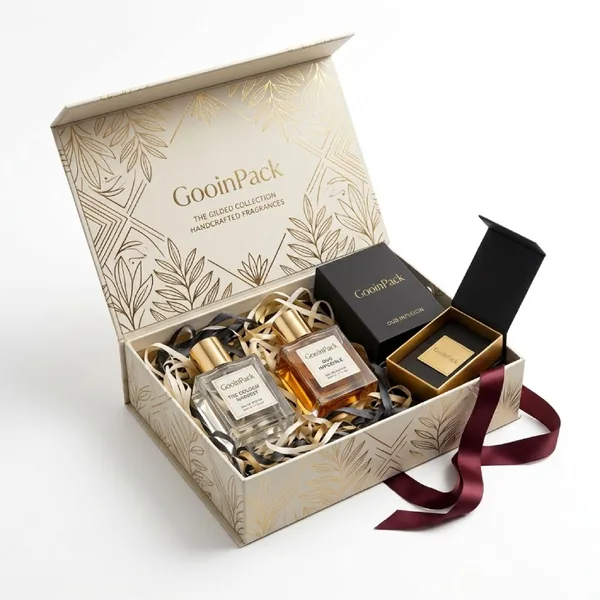
A cream rigid perfume box with gold botanical print, lid open over two glass bottles — one clear, one amber — in shredded paper, a small black box and burgundy ribbon

A perfume box is unusual because the object inside it is both heavy and fragile at the same time. A 100 ml glass flacon weighs several hundred grams and will break if it moves, but it cannot be gripped tightly because the neck and cap assembly is the weakest part of it. Almost every decision in a fragrance box follows from those two facts.

That makes the cradle the centre of the design rather than an accessory to it. The box has to hold the bottle still through a parcel network without bearing on the cap, and it has to present the bottle at a defined height when the lid is lifted, so that the flacon is the first thing seen.

Related reading: Premium perfume boxes for fragrance collections, Rigid perfume boxes built around a glass flacon.

What the bottle dictates

These are the constraints a fragrance box is engineered around. They are set by the glass, not by the brand.

Weight and centre of gravity

A filled 100 ml flacon is heavy enough that the box has to be sized against the filled weight, not the empty. If the centre of gravity sits high, the box tips when it is stood on a shelf and the bottle leans against the cradle wall, stressing the neck.

The cap is the fragile part

Caps and atomiser collars crack rather than bend, and they sit at the top of the bottle. A cradle that grips the body and leaves the cap entirely unloaded is the only arrangement that survives a drop. Gripping the neck to save space is the most common mistake in fragrance packaging.

Base impact

Parcels are dropped base-first far more often than they are dropped flat. The base of the box carries the impact, so the cushioning under the bottle matters more than the cushioning around it.

Glass clarity and shape

Fragrance glass is often faceted, tapered or asymmetric, and the reference bottle is a display object. A cavity has to locate a shape like that on its widest true plane, which usually means measuring the actual sample rather than working from a volume figure.

Component set completeness

A fragrance package is often a flacon plus a travel refill plus a cap or stopper. Each piece has to arrive in its own position, and the set has to hold together when the box is turned over.

Open and close as part of the product

The lid action is a designed moment for fragrance more than for almost any other category. How much resistance the closure has, and whether it stays open while the bottle is lifted out, is part of the presentation.

How the bottle is held

Cradle typeBest forWhat to know
Die-cut paperboard trayRigid boxes and lighter flacons up to around 50 mlCheapest to tool and easy to recycle, but offers limited cushioning. Best where the bottle is small or the box is shipped in an outer carton.
Foam or EVA cavityHeavier flacons and anything shipped as a direct parcelCut to the exact bottle profile with a controlled fit, so the cap never bears load. The most protective option and the usual choice above 50 ml.
Moulded pulp insertRanges where a natural, uncoated interior suits the brandGood cushioning and a material story that suits clean-beauty positioning. Tooling takes longer, so it suits an established range rather than a one-off.
Fabric-wrapped trayPremium and limited editionsWrap the tray in the same fabric as the box for a continuous surface when the lid lifts. Adds cost but gives the most considered opening.
Ribbon or tab liftTall flacons in a deep boxNot a cradle on its own — a lift that lets the bottle be extracted without fingers entering the cavity. Usually combined with one of the above.

Structures for fragrance

Magnetic closure box

The most common fragrance structure. The lid holds shut, opens to a defined angle and can be lifted off a shelf one-handed.

Rigid lid-and-base

A separate lid and base, where the lid is meant to be taken fully off and set down. Classic for a single flacon.

Drawer or sleeve

The bottle is drawn out on a tray rather than lifted, which suits a presentation where the reveal is horizontal.

Two-piece rigid

A tighter, more compact format for smaller flacons and travel sizes.

Book-style with fitted interior

Where the package presents the bottle alongside printed material or a second item.

Multi-bottle and coffret

Compartmented trays for a fragrance plus refill, or a collection across several flacons.

Finishing

Foil stamping

The dominant fragrance finish. Gold, silver and coloured foils on the wrap or the cradle for branding and borders.

Embossing and debossing

Tactile branding that reinforces the weight of the package and reads in the hand before the box is opened.

Soft-touch lamination

A matte, velvety surface that contrasts deliberately with the glass and metal of the flacon.

Fabric wrap

Linen and woven papers used on limited editions and coffrets, usually carried through to the tray.

Spot UV

Selective gloss for a single element against a matte field.

Metallic and pearlescent stock

A way to get a metallic read without full foil coverage, common on mid-range ranges.

StructuresMagnetic closure, rigid lid-and-base, drawer, two-piece, book-style, multi-bottle coffret
BoardGreyboard 2 mm – 3 mm, specified against the filled flacon weight
CradleDie-cut tray, foam or EVA cavity, moulded pulp, fabric-wrapped tray, ribbon lift
ClearanceCap and atomiser collar kept fully unloaded; fitment locates on the bottle body
Base protectionIncreased cushioning beneath the flacon to absorb base-first impacts
Wrap materialsCoated paper, specialty and textured stock, fabric, metallic and pearlescent paper
FinishingFoil, emboss, deboss, soft-touch and matte lamination, spot UV
SamplingPhysical sample with the actual bottle fitted, before every production run

Specifications are confirmed on your written quotation. Anything not written into the specification is not part of the order.

Board thickness is specified to⁠ ⁠ ISO 534,⁠ ⁠the standard method for the thickness, density and specific volume of paper and board, so a millimetre in a specification means the same thing to both sides.

Send the filled bottle, or a dimensioned drawing of it including the cap and any pump or collar, before the structure is fixed. Fragrance packaging cannot be developed reliably from a volume figure such as "100 ml": two bottles of the same volume can differ by 15 mm in height and by more than 100 g, and those two measurements decide both the box depth and the board thickness.

Questions buyers ask about perfume and fragrance

Why do you need the actual bottle rather than its volume?

Because volume does not describe the load. A 100 ml flacon from one supplier can be taller, wider and considerably heavier than a 100 ml flacon from another, and the cap assembly differs too. Depth, board thickness and cavity all follow from the real dimensions and the filled weight. A dimensioned drawing with the cap fitted is usually enough; a physical sample is better.

How do you stop the cap being damaged in transit?

By designing the cradle to locate the bottle on its body and leave the cap completely unloaded. The cavity is cut so the bottle cannot move laterally, and any load path runs through the glass body rather than through the neck. Gripping the neck is cheaper and is what causes most cap damage, so we do not do it.

Can the same box hold a flacon and a refill?

Yes. A compartmented or traced tray gives the refill its own pocket at the correct depth, so both pieces arrive located. Send the dimensions of every component including any travel case, and the tray is cut to hold them individually rather than as a loose set.

Do you produce gift sets with a printed insert card?

Yes. An insert card sits over the cradle to frame the bottle and carry brand or product copy. It is cut to register with the cavity, so it needs to be designed alongside the tray rather than added later.

What is the minimum order for a fragrance box?

It depends on the structure and the cradle. Rigid and magnetic structures start at 500 pieces because the dies and the tooling are fixed costs. Moulded pulp inserts carry longer tooling time, so they suit an established range rather than a first sample run. We will tell you plainly when a quantity is not economical rather than quoting it as though it were.

Tell us about your packaging project

Four required fields, with optional dimensions, project details and artwork attachments. The more of the optional detail you share — material, printing, finishing or insert requirements, reference images, a technical drawing, a destination country — the more specific our recommendation and quotation will be. Only the four required fields are marked with an asterisk.

Not sure? Choose “Not sure yet” and describe the product in the details box — we will recommend a structure.
Where the finished packaging is delivered. Freight and import duty depend on it.
AI, PDF, EPS, PSD, JPG, PNG or ZIP — up to 25 MB in total per enquiry.
PDF, AI, EPS, DXF, DWG or ZIP — a dieline or dimensioned drawing speeds up an exact quote.

We reply to every enquiry within two working days. Files are used only to prepare your quotation.

Since 200520+ years manufacturing packaging
two plantsFoshan & Guangzhou
ISO 900104626Q00932R001
AuditedMade-in-China.com · MIC-ASI261850