A single hero container
One jar or bottle gets the whole reveal. The lid lifts and the product is the only thing in the box, standing at the height the design intended.
A custom two-piece cosmetic box is a lid and a base held by friction. What decides whether it reads as premium is not the board — it is how far the skirt drops, and whether the two halves were printed together.
| Quantity | Unit price |
|---|---|
| 500 pcs | $1.50 – $4.00 |
| 1,000 pcs | $1.20 – $3.00 |
| 5,000 pcs | $0.80 – $2.20 |
Prices are indicative reference unit prices per box in USD, based on the stated order quantities. Actual pricing depends on box dimensions, materials, printing, finishing, inserts, order specifications and shipping terms. Final prices are confirmed through a written quotation.
Reference prices reviewed
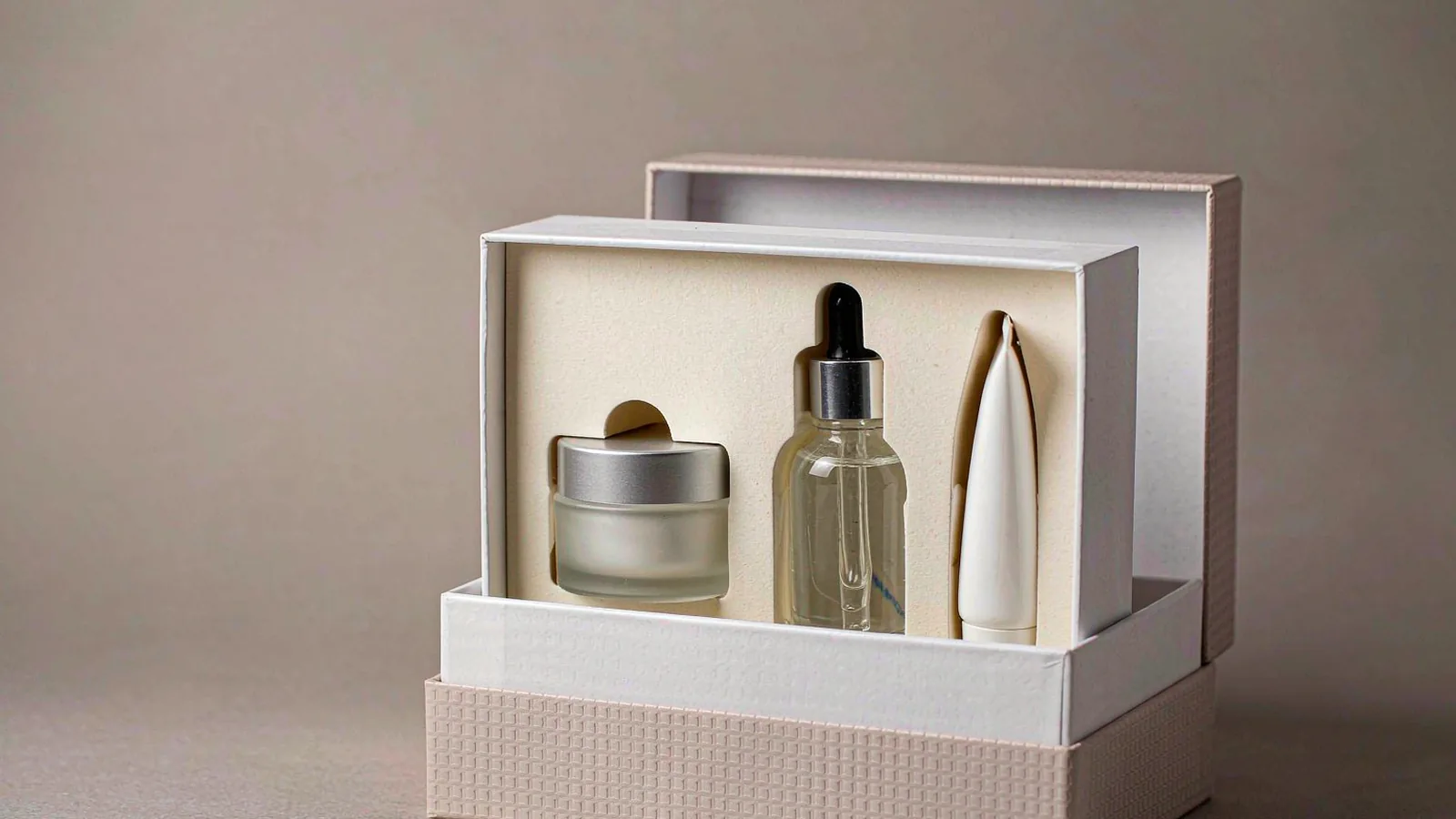
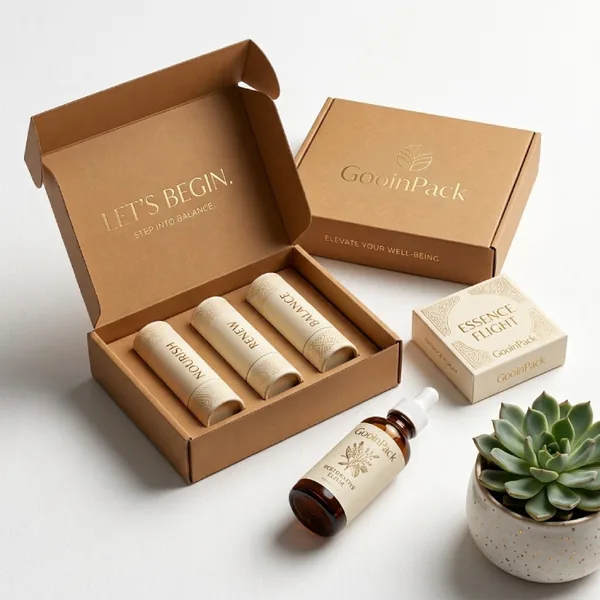
A two-piece cosmetic box is two wrapped trays: a base carrying the fitment and a lid that slides down over it. Nothing moves but the lid, and nothing wears except the line where the skirt meets the base.
Two things decide how it looks in the hand. The skirt drop — how far the lid comes down over the base — sets the proportion, because the exposed band beneath it is the only place the base is seen. And because the lid and base are separate pieces, they have to come off one print run, or the colour steps at the joint.
One jar or bottle gets the whole reveal. The lid lifts and the product is the only thing in the box, standing at the height the design intended.
Lid-and-base is a considered opening rather than a performance. It suits skincare sold on the container, where nobody is filming the lid.
No magnets, no spine, no ribbon and one fewer assembly step, so the same board and the same wrap come out cheaper per piece.
Refill and subscription programmes keep the base and reprint the lid, so a repeat run changes one component instead of two.
A serum, a cream or a face oil sold on the container, presented alone rather than in a set.
The base is retained and the lid is reprinted, so a repeat order moves one print piece.
A shopper at eye level sees a band of base under the lid; that proportion is a shelf decision as much as a design one.
Short runs where the structure is already proven and the print carries the variation.
The lid is the simplest closure there is, which puts the whole impression on two things — how deep the skirt drops, and whether the two halves match in colour. Both are settled before production, not corrected after it.
The lid comes down over the base by a set amount, and the band left showing beneath it is the only place the base wrap is seen. A deep skirt reads as a close-fitting box; a shallow one makes the lid look like a cap. The drop is set against the box height and fixes the board build before anything is printed.
Customise this boxThe gap between lid and base is the wrap thickness on both surfaces, so changing the paper changes the fit. Too tight and the lid will not lift without a struggle; too loose and it walks in transit. Where a client has a paper in mind, the fit is worked out from that paper rather than adjusted at assembly.
Customise this boxThey are separate wrapped trays, so they are separate print pieces. Printed on different runs the two halves step in colour at the joint, most visibly on a solid or a metallic. Both are printed on one sheet and wrapped from it, and a repeat order reprints both.
Customise this boxThe skirt rubs the base every time the box is opened. A matte laminate takes that abrasion better than soft-touch, which polishes where it is handled.
The lid is the whole visible face, so the brand mark can be larger here than on a hinged box without crowding anything.
A velvet surface, best where the box is opened once and kept. It marks at the skirt line under repeated handling.
Tactile branding that survives stacking, because nothing protrudes from a flat lid face.
Gloss detail over a matte field; on a two-piece box it reads as varnish on a printed surface rather than as hardware.
Textured stocks wrap the base band as well as the lid, so the texture has to survive a fold at the skirt edge.
| Structure | Rigid lid-and-base (two-piece) cosmetic box, no closure hardware |
|---|---|
| Skirt | Drop set against box height; the fit follows the wrap thickness on both surfaces |
| Print run | Lid and base printed on one sheet so the two halves match in colour |
| Containers | Jars, serum bottles, droppers, tubes, pumps, compacts |
| Board | Greyboard 1.5 mm – 2.5 mm, specified against filled product weight |
| Fitment | Compartmented tray, die-cut collar, foam or EVA cavity |
| Printing | Offset CMYK or Pantone spot, with foil, emboss, deboss or spot UV over it |
| Wrap materials | Coated paper, specialty and textured paper, printed paper |
| Finishing | Foil, emboss, deboss, spot UV, soft-touch and matte lamination, screen print |
| Minimum order | Typically from 500 pieces per size and specification; confirmed in your written quotation |
| Tolerance | Die-cut panels to ISO 2768-1 class m: ±0.2 mm up to 30 mm, ±0.3 mm up to 120 mm. An assembled box carries a wider allowance, because the wrap is applied by hand. |
| Assembled size | Finished outer dimensions ±0.8 mm, measured across the lid once the wrap has settled |
| Smallest box | L 80 × W 50 × H 15 mm formed. |
| Print sheet | Sheet-fed offset up to 1,100 × 1,600 mm; flexo up to 1,397 × 2,413 mm |
Specifications are confirmed on your written quotation. Anything not written into the specification is not part of the order.
Board thickness is specified to ISO 534, the standard method for the thickness, density and specific volume of paper and board, so a millimetre in a specification means the same thing to both sides.
Colour is controlled to ISO 12647-2, offset process control, measured against a physical Pantone reference rather than a screen.
The board, print method and finish named above are explained in the packaging options reference — what each option does, which materials it works on, and where it stops working.
All of it is made in our two plants in Nanhai, Foshan, and Panyu, Guangzhou: Metapackink is the manufacturer rather than a broker, so the board is cut, the wrap printed and the box assembled on our own floors, where the sample comes from.
Everything else — minimum order, lead times, Incoterms, shipping — is the same whichever box you buy, and is set out under the table.
| OEM / ODM | We offer complete OEM and ODM for two-piece cosmetic boxes. ODM means fitting an existing lid-and-base structure to your range; OEM means developing the fitment, the skirt drop and the print build from your containers. |
|---|---|
| Checked on the sample | The sample is the only place the friction fit can be judged, so it is sent assembled and opened by the client rather than photographed. Where a specific paper has been agreed, the sample is made in that paper. |
| Warranty | Two-piece cosmetic boxes are warranted against the approved sample for skirt drop, colour match between lid and base, and fitment clearance — the three things that go wrong on this structure and are invisible in an artwork approval. |
Minimum order quantities are generally based on box size, structure and specifications. Standard custom orders typically start at 500 pieces per size and specification. Available stock sizes, simpler structures and repeat orders may allow lower quantities; special materials, complex structures and custom inserts may require higher minimums. Your written quotation confirms the minimum for your specification. Samples take 4 – 6 working days from approved artwork. Sample lead time is a separate stage from production; courier time is additional. Production takes 10 working days from the later of receipt of the cleared deposit or written sample approval. Transit time is additional. Shipping terms: EXW, FOB, CIF or DDP, sea, air or courier. Sequence and inspection: process · quality control.
Tight enough to lift with a little resistance, not so tight that it needs two hands or traps air. Because the fit comes from the wrap thickness, it is fixed when the paper is chosen — so the paper is settled before the box is built, not after.
They are separate pieces, and colour drifts between runs. On a solid or a metallic the step at the joint is the first thing anyone notices. One sheet, one run, both halves wrapped from it — and a repeat order reprints both.
A friction fit is a fit, not a lock. Under long vibration the lid can walk a millimetre at a time. For a box that travels loose in a bag, a magnetic closure is the better structure and we will say so; for palletised retail distribution the lid stays put.
It can be mounted in the base, but it is then used from above rather than face on. A mirror is the usual reason a cosmetic structure moves to a hinged lid — this page’s structure is chosen when no mirror is needed.
No magnets, no spine, no ribbon and one fewer assembly step. The saving is per unit and grows with the run, which is why it matters least on a 500-piece order and most on a volume programme.
Shape, insert and industry change what two-piece cosmetic boxes can do without changing the structure underneath. Board and finishing are shared across the factory.
Finishing and board options are shared across the factory — how each is applied is on the manufacturing process page, and the structures they can be built into are on packaging solutions.
Commonly bought for Beauty and skincare