Where the deck steps
A 30 ml dropper and a 150 ml toner are 120 mm apart in height. One flat tray either swallows the short one or lifts the tall one into the lid, so the deck is cut in steps.
A luxury cosmetic box is a presentation box built around a regimen rather than a single product — a tall toner, a short jar, a dropper in between — and it has to keep all of them still, let them out every morning, and still close on the same line a year later.
| Quantity | Unit price |
|---|---|
| 500 pcs | $0.25 – $1.50 |
| 1,000 pcs | $0.18 – $1.00 |
| 5,000 pcs | $0.10 – $0.70 |
Prices are indicative reference unit prices per box in USD, based on the stated order quantities. Actual pricing depends on box dimensions, materials, printing, finishing, inserts, order specifications and shipping terms. Final prices are confirmed through a written quotation.
Reference prices reviewed
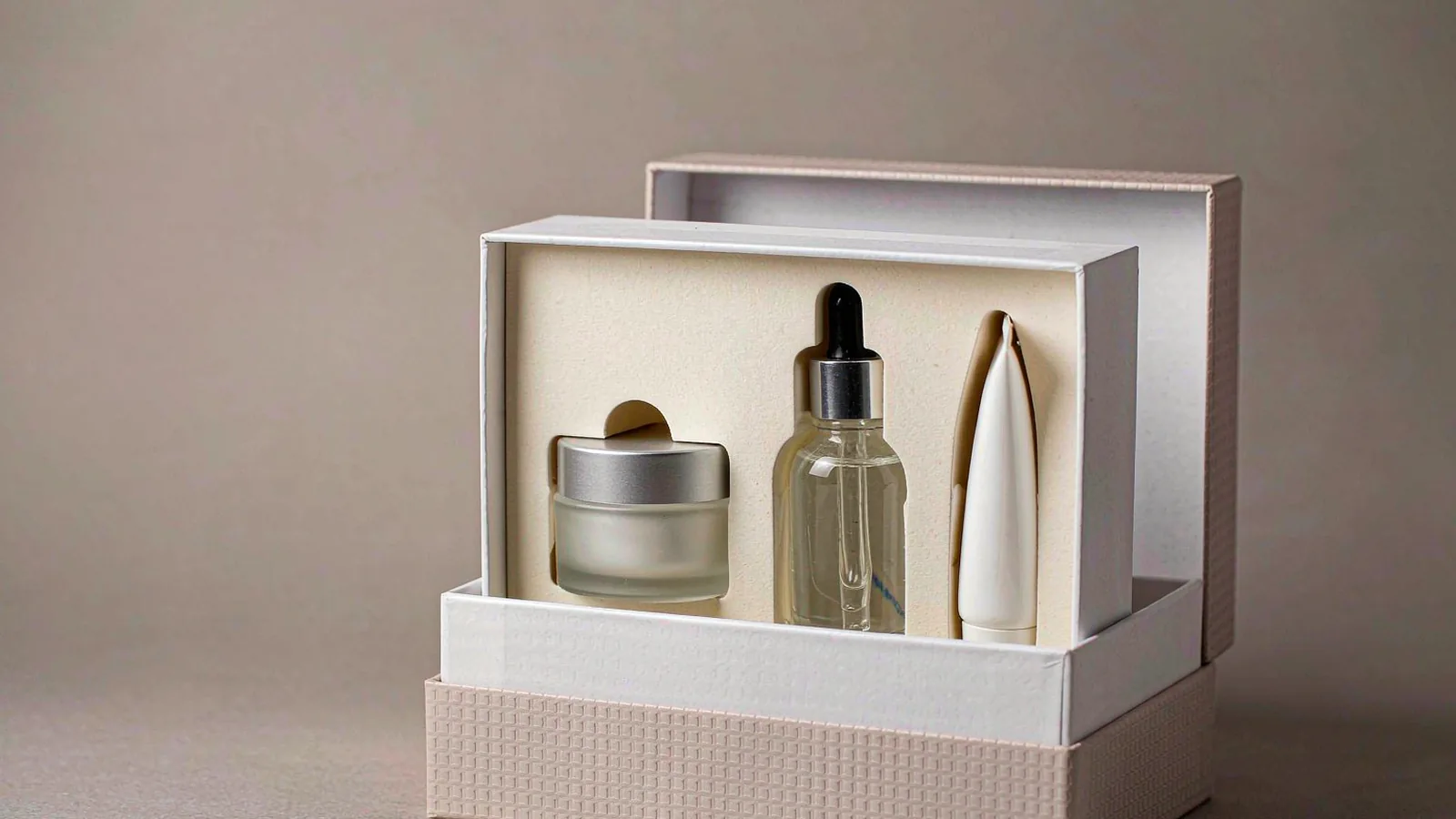
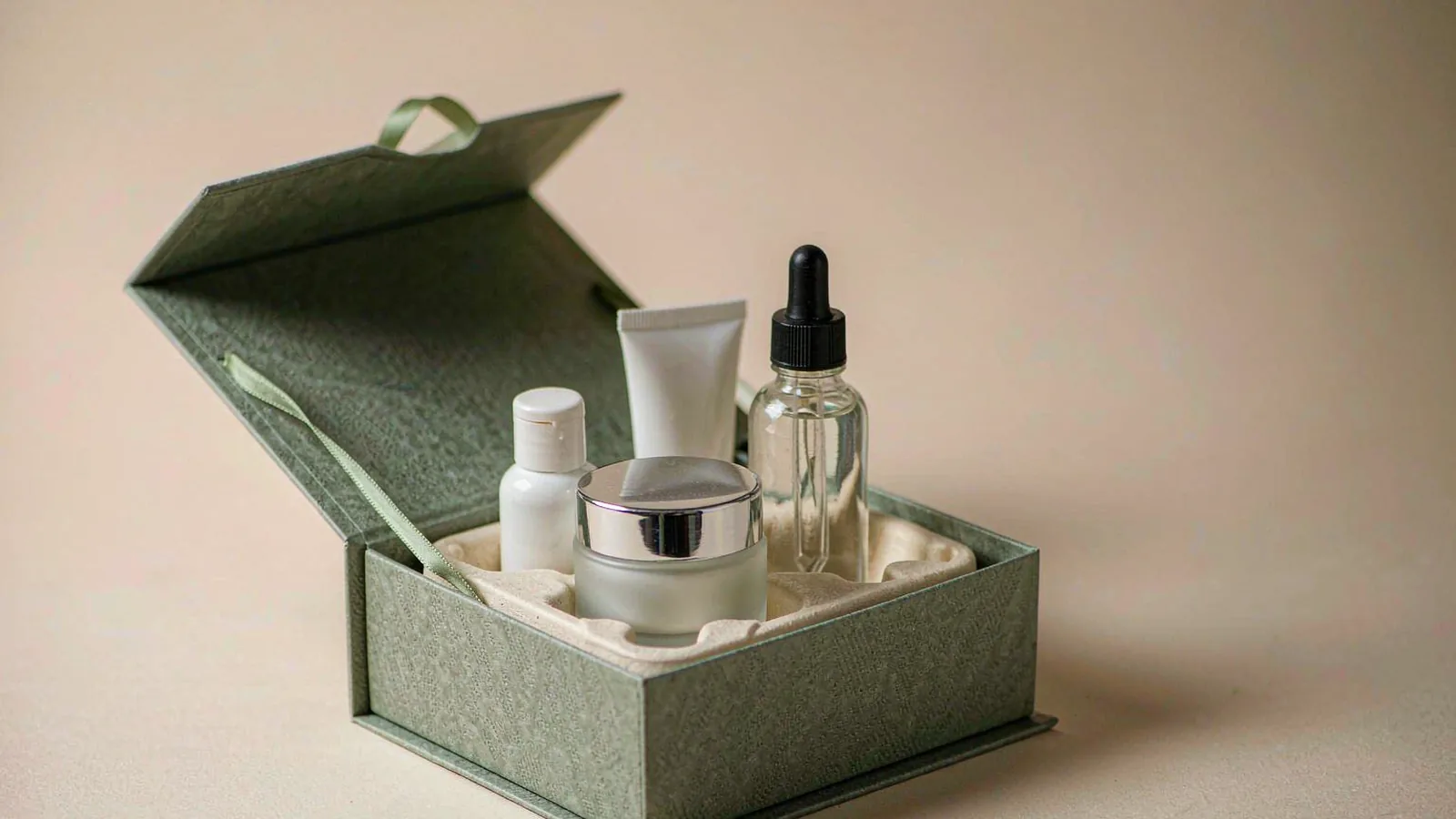

That is the difference from packaging a single bottle. Three containers mean three heights, three diameters and usually three materials: glass for the serum, coated glass or PET for the toner, aluminium or ABS for the cap. A tray cut flat holds whichever one it was modelled on and lets the other two move, and movement between two glass units is how a scuff becomes a chip before the box has left the pallet.
So the fitment is the design, and the surface is the second decision. We cut the deck to the container mix — one ledge per height, walls between neighbours, headroom measured above the tallest actuator rather than above the box — and then specify the wrap and the finish on a box that already holds its contents properly. Where the products can leak, the cavity is coated or made lift-out, because a spill in an unsealed greyboard box is permanent.
A 30 ml dropper and a 150 ml toner are 120 mm apart in height. One flat tray either swallows the short one or lifts the tall one into the lid, so the deck is cut in steps.
Glass against glass in transit is a scuff first and a chip second. The wall between two cavities is a specified dimension, not the space left over.
Pumps, sprayers and caps stand above the deck line. Lid depth is measured against the tallest one with every container loaded, not against the box.
A skincare box lives on a dresser and is unpacked and repacked constantly. Grip that relaxes after fifty removals is the failure foam shows first.
Cleanser, toner, serum and cream: four heights, four diameters and two materials in one cavity.
Palettes and compacts are the only rigid items; brushes and pencils have to be held without being crushed.
Miniatures of similar height but different diameters, spread across one shallow deck.
A refill pod and its outer shell in the same box, so one cavity has to release and the other has to hold.
Expensive here is not one surface decision. It is four objects at four heights that none of them can move out of, in a box that still closes on the same line after a year on a dresser — and the wrap is chosen once that is true, not instead of it.
A serum dropper, a cream jar and a toner bottle differ by more than 100 mm, so a flat cavity holds exactly one of them. A stepped deck, cut from the same die, gives each container its own ledge at its own height, so every unit presents at the same level when the lid comes off and none of them is resting on a neighbour. The step is settled before the artwork, because it changes the interior depth and therefore the box.
Customise this boxTwo glass units in one tray rub against each other through every handling step, and a chip starts as a scuff nobody photographed. Wall thickness between cavities, radial clearance at the contact height and the points where the two units are permitted to touch are specified per container — they are not whatever the box size leaves over. The drop test runs with the set fully loaded, because an empty tray passes everything.
Customise this boxCosmetics carry liquid, and a leak wicks into greyboard and stays there: the corner goes soft, the wrap lifts, and an unsealed box cannot be cleaned. Where the products can leak, the cavity is coated or laminated, or the whole fitment lifts out as a tray that can be wiped — which is also what lets the box keep working as a dresser tray instead of being thrown away after the second month.
Customise this boxMetallic and speciality foil for brand marks, borders and fine detail — the signature luxury finish.
A velvety matte surface standard across premium beauty and resistant to scuffing.
Tactile brand marks, often combined with foil on the same element.
Gloss detail layered over a matte, soft-touch surface.
Heavy textured and metallised stock for a surface the hand reads as premium.
Colour-matched satin ribbon and decorative closures as part of the construction.
| Structures | Magnetic closure, lid-and-base, drawer, book-style |
|---|---|
| Containers | Jars, droppers, pumps, tubes, compacts, palettes, travel sizes |
| Set sizes | Two to six containers in one box, across two or three deck heights |
| Colour | Any Pantone, CMYK or metallic shade; metallised and pearlescent boards available |
| Printing | Offset CMYK or Pantone spot colour, with foil, emboss, deboss or spot UV over it |
| Board | Greyboard 1.5 mm – 2.5 mm, specified against the loaded weight of the whole set |
| Fitment | Stepped die-cut deck, compartmented tray, foam or EVA where a shape is irregular |
| Liquid protection | Coated or laminated cavity, or a lift-out tray, where a container can leak |
| Minimum order | Typically from 500 pieces per size and specification; confirmed in your written quotation |
| Tolerance | Die-cut panels to ISO 2768-1 class m: ±0.2 mm up to 30 mm, ±0.3 mm up to 120 mm. An assembled box carries a wider allowance, because the wrap is applied by hand. |
| Assembled size | Finished outer dimensions ±0.8 mm, measured across the lid once the wrap has settled |
| Smallest box | L 80 × W 50 × H 15 mm formed. |
| Print sheet | Sheet-fed offset up to 1,100 × 1,600 mm; flexo up to 1,397 × 2,413 mm |
Specifications are confirmed on your written quotation. Anything not written into the specification is not part of the order.
Board thickness is specified to ISO 534, the standard method for the thickness, density and specific volume of paper and board, so a millimetre in a specification means the same thing to both sides.
Colour is controlled to ISO 12647-2, offset process control, measured against a physical Pantone reference rather than a screen.
The board, print method and finish named above are explained in the packaging options reference — what each option does, which materials it works on, and where it stops working.
All of it is made in our two plants in Nanhai, Foshan, and Panyu, Guangzhou: Metapackink is the manufacturer rather than a broker, so the board is cut, the wrap printed and the box assembled on our own floors, where the sample comes from.
Everything else — minimum order, lead times, Incoterms, shipping — is the same whichever box you buy, and is set out under the table.
| OEM / ODM | We offer complete OEM and ODM for luxury cosmetic packaging. ODM means fitting an existing luxury structure to a regimen of containers; OEM means developing the stepped deck, the closure and the finish from your brief. |
|---|---|
| Checked on the sample | The sample is approved with every container loaded, because a deck that holds one jar correctly can still pinch a second — and a set has more ways to be wrong than a single bottle. |
| Warranty | Luxury cosmetic packaging is warranted against the approved sample for wrap appearance, finish adhesion, deck height and the clearance between neighbouring containers. |
Minimum order quantities are generally based on box size, structure and specifications. Standard custom orders typically start at 500 pieces per size and specification. Available stock sizes, simpler structures and repeat orders may allow lower quantities; special materials, complex structures and custom inserts may require higher minimums. Your written quotation confirms the minimum for your specification. Samples take 4 – 6 working days from approved artwork. Sample lead time is a separate stage from production; courier time is additional. Production takes 10 working days from the later of receipt of the cleared deposit or written sample approval. Transit time is additional. Shipping terms: EXW, FOB, CIF or DDP, sea, air or courier. Sequence and inspection: process · quality control.
With a stepped deck: one die-cut tray cut to two or three levels, each container sitting on its own ledge. The tallest unit sets the lid depth and the shortest sits high enough that it does not rattle. The step is decided from your filled container list before the dieline is drawn, because it changes the interior depth and the box along with it.
Only if the walls between them are treated as leftover space. Wall thickness and radial clearance are specified per container, and the points where two units are allowed to touch are named rather than assumed. The drop test runs with the set loaded, since an empty tray passes tests that a full one fails.
Yes, if the fitment lifts out. A lift-out tray is what makes that possible, and it is also the answer where a product can leak, because a cavity sitting in the base cannot be cleaned. Foam is the material that shows wear first in repeated use; a die-cut board deck holds its grip far longer.
It wicks into the greyboard and stays there — the corner softens, the wrap lifts, and the box cannot be cleaned. Where leakage is a real risk the cavity is coated or laminated, or the fitment is removable; the decision is made from the container type, not added later as a lining.
Consistency across the set rather than one hero surface. Four containers held at one level, a lid that closes on the same line every time, a finish that still reads as new after a year on a dresser. Foil and soft-touch are the means; a box that holds a regimen without a rattle is what the buyer actually notices.
Shape, insert and industry change what luxury cosmetic packaging can do without changing the structure underneath. Board and finishing are shared across the factory.
Finishing and board options are shared across the factory — how each is applied is on the manufacturing process page, and the structures they can be built into are on packaging solutions.
Commonly bought for Beauty and skincare