The glass is round
A circular body with a circular collar needs no corner fill and no foam. The bottle sits on its own foot, held at the shoulder, and the box follows the product instead of boxing it in.
A cylinder box for a flacon is a fit problem before it is a printing job: the diameter comes from the widest point of the glass, the height from the cap, and the collar from the shoulder. This page is about that fit rather than about the tube.
| Quantity | Unit price |
|---|---|
| 500 pcs | $1.00 – $3.50 |
| 1,000 pcs | $0.70 – $2.50 |
| 5,000 pcs | $0.40 – $1.50 |
Prices are indicative reference unit prices per box in USD, based on the stated order quantities. Actual pricing depends on box dimensions, materials, printing, finishing, inserts, order specifications and shipping terms. Final prices are confirmed through a written quotation.
Reference prices reviewed
Metapackink is a custom cylinder perfume box manufacturer based in Guangzhou, China. The company offers custom cylinder perfume boxes, with customization options for dimensions, materials, printing and finishing. Minimum order quantities are generally based on diameter and product specifications. Standard custom orders typically start at 500 pieces per diameter and specification. Available stock diameters, simpler structures and repeat orders may allow lower quantities; special materials, complex structures and custom inserts may require higher minimums. Your written quotation confirms the minimum for your specification.
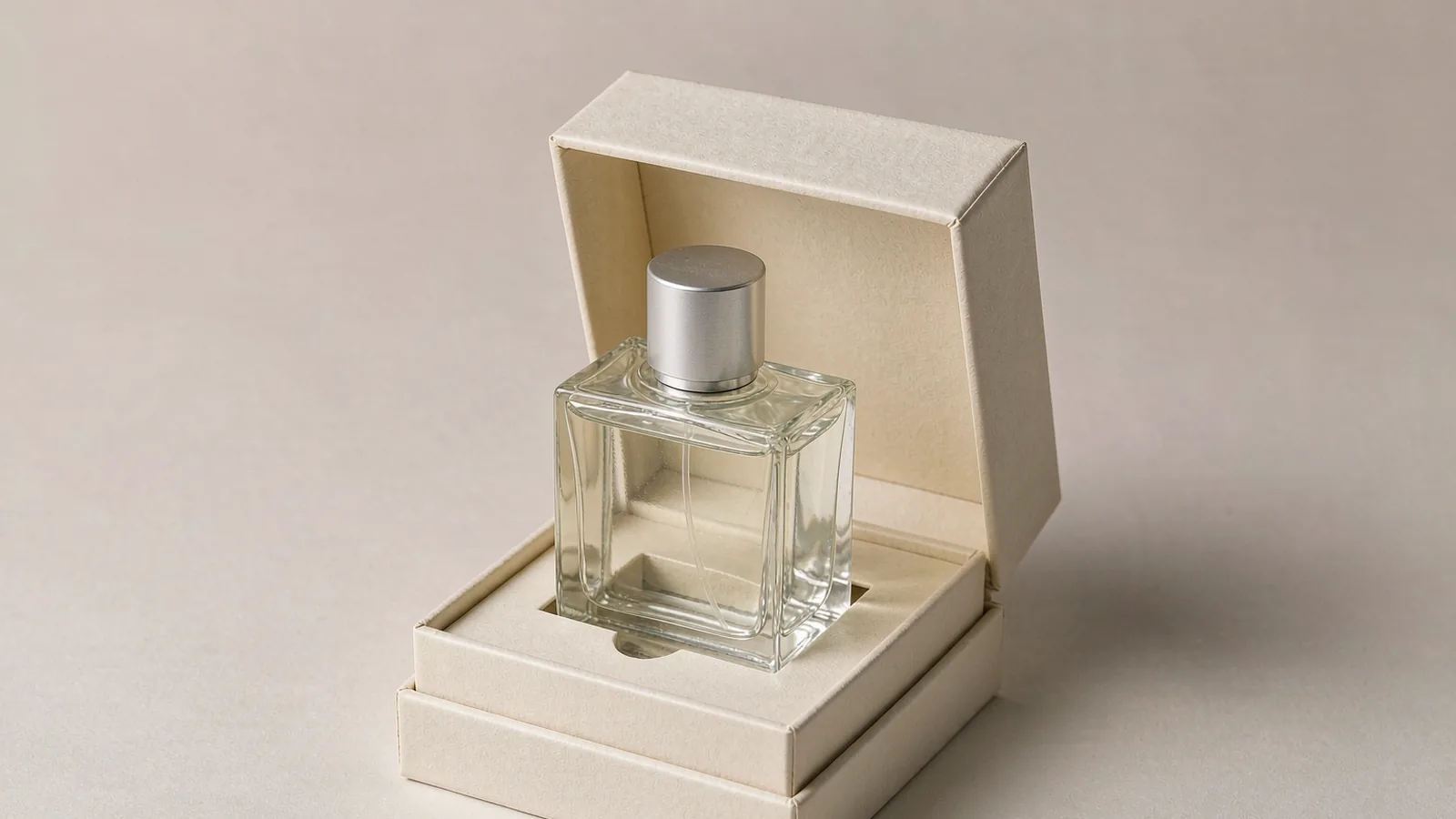
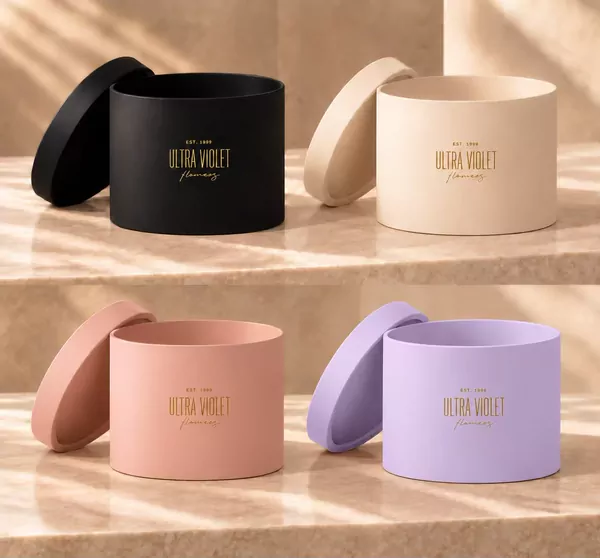
A round box and a round flacon look like a natural pair, and most of the time they are — but not because both are round. They work because a circle locates a circle: once the collar is cut to the shoulder, the bottle has one place to sit and no corner to drift into. A square flacon in the same box has the opposite problem. Four corners of dead volume let the glass rotate until the shoulder finds the wall, and the scuff that follows is the first thing a buyer sees when the lid comes off.
The order of measurement is fixed and it is not the order most artwork arrives in.
Glass first: the widest point of the body, which on a flacon is usually the shoulder rather than the base. Cap second: overall height with the closure on, and whether the cap is wider than the neck, because a magnetic or oversized cap changes where the lid recess has to be. Collar third: the aperture that catches the shoulder without pinching it. Print last, on the surface that is left. A box drawn from the artwork and fitted to the bottle afterwards is how a lid ends up closing on the bench and binding on a loaded sample.
The lid is where perfume separates from every other cylinder. A telescoping lid covers most of the wall, which protects a tall bottle in a bag and hides the wrap seam; a shoulder-neck lid stops on an inner neck, so the printed band ends exactly where the glass begins and the bottle is visible from the front. Both are correct, for different retail contexts, and the choice changes the amount of visible glass more than it changes the price.
A circular body with a circular collar needs no corner fill and no foam. The bottle sits on its own foot, held at the shoulder, and the box follows the product instead of boxing it in.
A tall spray cap or a sculpted stopper is the usual reason a cylinder lid has to be deeper than the body height. Getting that depth wrong is what makes a lid bind only when the bottle is inside.
A lid lifting off a circle is a slower, more deliberate gesture than a flap, and for fragrance that pause is part of the product. It is a presentation decision, not a structural one.
A 30 ml, 50 ml and 100 ml in the same glass family can often share one tube diameter and differ only in height and collar, which keeps a range consistent on shelf and cheaper to repeat.
The volume that carries most of a fragrance line. A 50 ml flacon is heavy enough to need a reinforced base and light enough that a wound tube is still viable; a 100 ml usually moves to wrapped greyboard.
Smaller volume, heavier glass, often a stopper rather than a spray. The collar is cut tighter because the bottle is short and the box would otherwise feel empty in the hand.
A slim cylinder is the natural format for a travel spray: it protects a narrow bottle in a bag and takes a full-wrap print on a small surface, which is where a brand mark reads best.
A full bottle and a 7.5 ml miniature in one cylinder need a divider disc and two collar apertures. The miniature never sits loose against the full bottle.
A refillable flacon is opened repeatedly, so the lid fit is specified for cycles rather than for one reveal, and the interior print is chosen to survive the handling.
Several small vials in one tube, separated by a divider star so the glass cannot travel as a block. The tube is a container here, and the lid is the reseal.
Four measurements decide the box, and they are taken in this order: glass, cap, collar, print. Taken in any other order, the sample is where the mistake appears.
Not the base. On most flacons the shoulder is wider than the foot, and a box measured at the base will not accept the bottle. The working diameter is that widest point plus a location clearance, and the clearance is what the collar takes up rather than a gap the bottle can move in.
Customise this boxA die-cut disc with an aperture larger than the cap and smaller than the body drops over the bottle and stops where the glass widens. The foot carries the weight and the collar only stops lateral movement. A square flacon in a round box cannot be located this way, so it takes corner fill — EVA or moulded pulp — instead of a disc.
Customise this boxThe inside of the lid carries a recess deep enough for the closure and wide enough that the cap does not touch the wall. A magnetic cap is the case that catches people out: if the recess floor is too close, the magnet pulls the lid down and the box will not stay closed square.
Customise this boxGlass is the heaviest thing in the box. Where a flacon is 100 ml or the wall is a wound tube, an extra board disc goes into the base so the wall does not bow under the bottle in a stack or in transit.
Customise this boxThe dominant finish on fragrance. A crest on a curved face needs its own die and its own registration check, because a flat die does not wrap a circle evenly.
A velvet surface that reads as expensive in the hand and hides the wrap join on a rolled cylinder.
Kept small on a cylinder: a large relief distorts around the circumference, and the distortion is visible from arm’s length.
Gloss detail over a matte field, most useful on a dark wrap where foil would be too loud.
Has to survive being rolled without cracking at the seam, which is why the wrap is tested before it is specified.
A single colour inside the tube. It is the first surface a customer sees and the cheapest place to put a line of copy.
| Structure | Round rigid cylinder, shoulder-neck or telescoping |
|---|---|
| Diameter | Set from the widest point of the flacon |
| Height | Set from overall height with the cap on |
| Internal diameter | Measured from your bottle; confirmed on a loaded sample |
| Fitment | Disc collar at the shoulder, corner fill for shaped flacons |
| Lid recess | Cut to the closure height, clear of the cap wall |
| Base | Reinforced board disc under heavy glass |
| Wall / board | Greyboard 1.5 – 3 mm, or tube wall 1.5 – 2.5 mm |
| Printing | Offset CMYK or Pantone spot; digital for short runs |
| Finishing | Foil, emboss, deboss, spot UV, soft-touch, textured or fabric wrap |
| Minimum order | Typically from 500 pieces per diameter and specification; confirmed in your written quotation |
| Sample lead time | 4 – 6 working days from approved artwork |
| Tolerance | Die-cut panels to ISO 2768-1 class m: ±0.2 mm up to 30 mm, ±0.3 mm up to 120 mm. An assembled box carries a wider allowance, because the wrap is applied by hand. |
| Assembled size | Finished outer dimensions ±0.8 mm, measured across the lid once the wrap has settled |
| Working range | Diameter 40 – 200 mm wrapped (50 – 150 mm wound paper tube) × height 30 – 300 mm. |
| Print sheet | Sheet-fed offset up to 1,100 × 1,600 mm; flexo up to 1,397 × 2,413 mm |
Specifications are confirmed on your written quotation. Anything not written into the specification is not part of the order.
Board thickness is specified to ISO 534, the standard method for the thickness, density and specific volume of paper and board, so a millimetre in a specification means the same thing to both sides.
Colour is controlled to ISO 12647-2, offset process control, measured against a physical Pantone reference rather than a screen.
The board, print method and finish named above are explained in the packaging options reference — what each option does, which materials it works on, and where it stops working.
All of it is made in our two plants in Nanhai, Foshan, and Panyu, Guangzhou: Metapackink is the manufacturer rather than a broker, so the board is cut, the wrap printed and the box assembled on our own floors, where the sample comes from.
Everything else — minimum order, lead times, Incoterms, shipping — is the same whichever box you buy, and is set out under the table.
| OEM / ODM | We offer complete OEM and ODM for perfume cylinder boxes. ODM means fitting an existing diameter and lid to your flacon; OEM means developing the diameter, the collar and the lid recess from the bottle itself. |
|---|---|
| Checked on the sample | A perfume cylinder sample is approved with the bottle inside and the lid lifted on and off, because a recess cut too shallow only shows once the cap is in place. |
| Warranty | Perfume cylinder boxes are warranted against the approved sample for collar clearance, lid fit, recess depth and base strength under the filled bottle. |
Minimum order quantities are generally based on diameter and product specifications. Standard custom orders typically start at 500 pieces per diameter and specification. Available stock diameters, simpler structures and repeat orders may allow lower quantities; special materials, complex structures and custom inserts may require higher minimums. Your written quotation confirms the minimum for your specification. Samples take 4 – 6 working days from approved artwork. Sample lead time is a separate stage from production; courier time is additional. Production takes 10 working days from the later of receipt of the cleared deposit or written sample approval. Transit time is additional. Shipping terms: EXW, FOB, CIF or DDP, sea, air or courier. Sequence and inspection: process · quality control.
A round box built around a flacon rather than around a shelf size: the diameter follows the widest point of the glass, the collar is cut to the shoulder, and the lid carries a recess for the cap. It can be a wound paper tube or a wrapped greyboard cylinder.
Yes, or a dimensioned drawing of it. The three figures that matter are the widest point of the body, the overall height with the cap on, and the cap diameter. Without them the diameter is a guess, and a guess is what the sample is spent correcting.
A shoulder-neck lid stops on an inner neck, so the printed band ends where the glass begins and the bottle is visible from the front — the usual choice for retail. A telescoping lid covers more of the wall, which protects a tall bottle in a bag and hides the wrap seam — the usual choice for travel and e-commerce.
Yes, but not on a disc collar. A shaped or square flacon needs corner fill — EVA or moulded pulp — because the collar cannot catch a shoulder that has no continuous radius. The fill is cut to the glass, so the bottle does not rotate into the wall.
No. The boxes ship flat or nested, empty; the flacon is filled and packed at your end. Air freight rules for alcohol-based fragrance apply to the liquid, not to an empty box, so a packaging order is not affected by them.
Shape, insert and industry change what perfume cylinder boxes can do without changing the structure underneath. Board and finishing are shared across the factory.
Finishing and board options are shared across the factory — how each is applied is on the manufacturing process page, and the structures they can be built into are on packaging solutions.
Commonly bought for Fragrance