A Gift Box for a Distillery: Carrying a Heavy Bottle Without Adding a Handle
Client a craft distillery
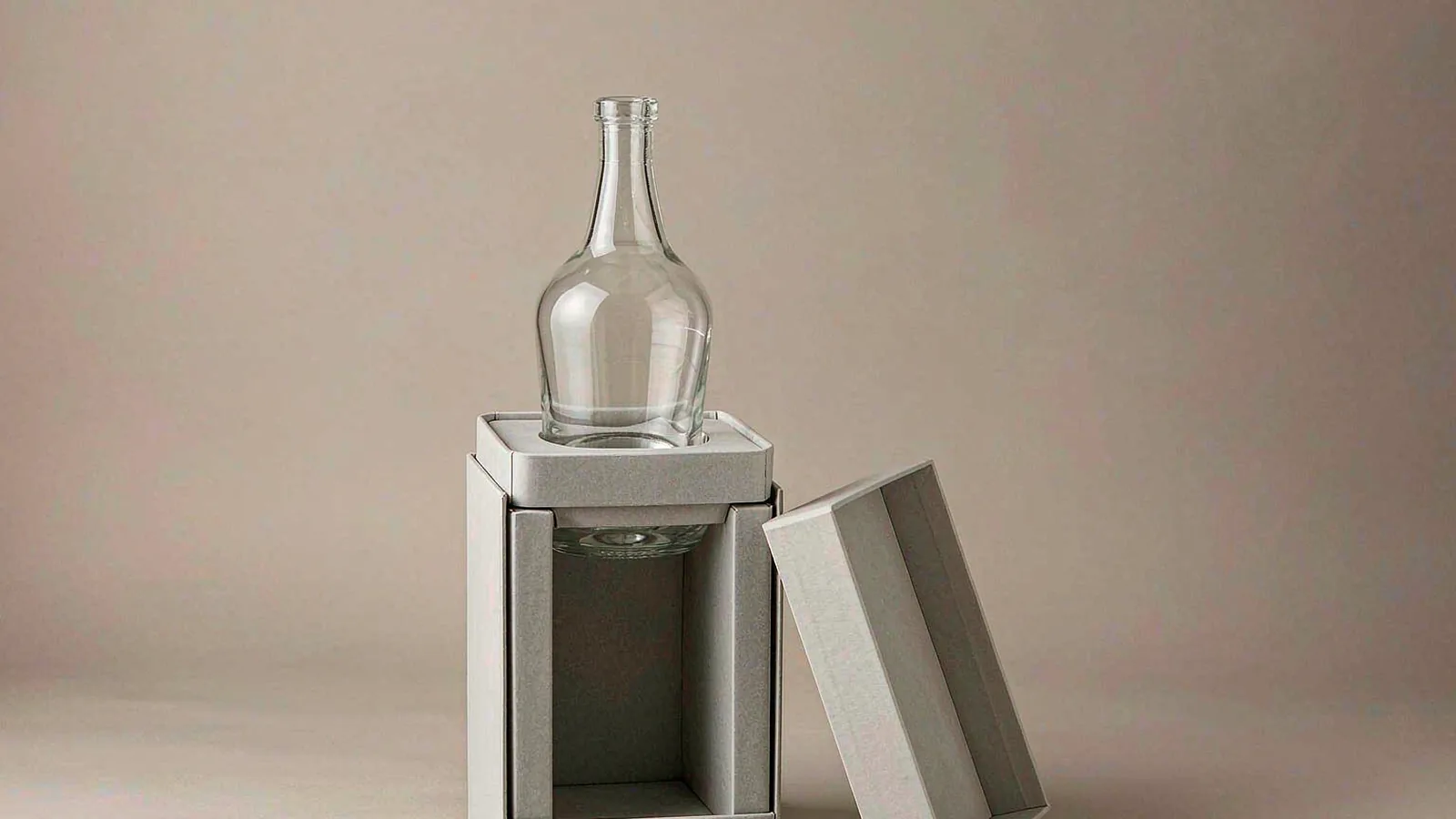
At a glance
- Client industry
- Spirits
- Packaging type
- Two-piece boxes
- Material and wrap
- 2.5 mm greyboard on the base and collar, 2.0 mm on the lid. The base is thicker because it carries the load; the lid is thinner because it does not, and this is the saving that paid for the collar.157 g coated paper, printed CMYK, matte lamination, foil-blocked logo on the lid and the sleeve
- Box structure
- two-piece rigid box with an internal collar, lid 32 mm deep, base 118 mm deep, collar standing 30 mm proud
- Insert type
- wrapped greyboard cradle with a die-cut flange landing on the collar ledge; 6 mm clearance above the stopper, 4 mm below the punt
Project summaryA craft distillery needed a box that carries a heavy bottle without a handle, since a handle loads one panel of board. It was built as a two-piece rigid box with an internal collar — a 32 mm lid, a 118 mm base, a 30 mm-proud collar, on 2.5 mm base and collar board with a 2.0 mm lid — with a CMYK matte wrap and a foiled logo. The carry load is spread by a wrapped greyboard cradle, die-cut with a flange resting on the collar ledge, holding 6 mm clear above the stopper and 4 mm below the punt, with a 12 mm undercut grip and a 200 gsm banded sleeve, the collar glued on all four sides.
A handle moves the whole load into one panel of board. There is a better way to make a heavy box easy to carry, and it costs less than a handle does.
The brief was a single-bottle gift box for a 70 cl spirit, sold through retail and distillery-shop channels, in a structure substantial enough to be given rather than mailed. It had three requirements: the bottle had to be visible when the box was opened, the box had to feel heavy in the right way, and it had to be easy to carry out of a shop with one hand.
The third requirement was the only difficult one, and it was answered in the brief with a handle. Removing the handle and solving the problem underneath it is what this project turned into.
As with the other case studies, the brand, the artwork and the commercial figures are left out. Dimensions, board, structure, insert material and the test results are not, because those are the parts a buyer running a similar project can reuse.
The bottle being boxed
- 70 cl glass bottle, 312 mm tall including the stopper
- 94 mm diameter at the base, tapering to a long neck
- 1.36 kg filled — the glass is the weight, not the contents
- A heavy base with a deep punt, so the centre of gravity sits low
Two properties of that list decide everything else. The mass is high and concentrated at one end, and the height is such that any box built around it is tall and narrow — which is the worst possible shape to carry by anything attached to the top.
What the brief asked for
A rigid box with a rope handle through the lid, a window in the front panel, foil-blocked branding, and a moulded insert. It is a normal brief, and it is what most spirit gift boxes are.
The handle was not a decorative request. It came from a real observation: customers pick the box up by the lid, the lid separates from the base, and the bottle falls. A handle is the obvious way to stop that, and it is the wrong one.
Why the handle was the wrong answer
A handle does not distribute a load. It concentrates it, and then it moves it into the weakest place in the structure.
Four problems, in the order they would have appeared:
- The whole weight lands in two holes. A rope handle carries 1.36 kg plus the weight of the box through two holes punched in one panel of board. Board is weak in exactly the direction that asks for: the failure is pull-through or delamination at the hole, not the rope breaking. Every heavy handled box is a reinforcement problem wearing a convenience problem's clothes.
- Reinforcement costs more than the handle. Making it hold means washers or eyelets, an internal doubler, and a bonded patch spreading the load into the panel. That is three added components, three added assembly steps, and a visible metal fitting on a box whose whole job is to look considered.
- The load hangs above the centre of gravity. A tall narrow box carried from a point above its own centre swings. A 1.36 kg bottle swinging on a rope is how a box hits a doorframe, and it is how a customer discovers the handle was the only thing holding the lid on.
- A handle makes the box bigger. It protrudes, so the export carton needs void around it, and the box cannot be shrink-wrapped flat against its neighbours. On a heavy product the freight is already the second largest cost line; adding volume to it is spending money to buy a worse structure.
Underneath all four there is the real objection. Customers lift the box by the lid because that is the part their hand reaches, not because the box lacks a handle. The fix is to give them a better place to put their hand, not to add something to the lid.
Where the weight should go instead
Board behaves very differently in compression and in bending, and a heavy rigid box should be built so that the weight travels through the direction board is good at.
In a plain two-piece box, the bottle sits on the base floor. The base floor is a horizontal panel supported at its edges, so the load puts it in bending — the direction in which a 2 mm greyboard panel of that span will visibly deflect under 1.36 kg, and will creep rather than recover over a long shelf life. The walls, by contrast, are loaded in compression along their vertical axis, which is what greyboard does well.
So the load path to aim for is: bottle → insert → the vertical walls of the base → the surface the box stands on. A structure that achieves it does not need thicker board, and a structure that does not will never be fixed by thicker board alone.
The way to achieve it is a collar. A shoulder-and-neck box — described in more detail on the shoulder neck gift box page — has a third component between the lid and the base: a four-sided frame glued inside the base, standing proud of it. The lid sits onto that frame rather than onto the base, and critically, the frame provides a ledge inside the box at a controlled height.
The decision: a collar box, and the bottle sits on the collar
The box was built as a two-piece rigid box with an internal collar, and the insert was designed to land the bottle on the collar rather than on the base floor.
That sentence is the project. The collar's top edge is a load-bearing ledge running around all four walls. The insert is a wrapped board cradle whose outer flange is wider than the gap between the collar walls, so the flange rests on the ledge and the bottle's weight transfers into the collar — and from the collar, straight down the four vertical walls of the base into whatever the box is standing on.
The base floor carries almost nothing. It is still there, it still closes the box, and it is no longer a structural member. That is the difference between a box that holds a heavy bottle and one that slowly sags under it.
Two things followed from the same decision. Because the lid closes onto the collar rather than onto the base, the lid no longer has to be structural at all — it can be shallower, lighter and cheaper, and nothing is lost. And because the collar stands proud by 30 mm, the box acquires a visible shoulder line, which on a spirits box reads as a deliberate design feature rather than as a structural necessity.
How it is actually carried
Removing the handle left the original problem unsolved, so it was solved directly: give the hand somewhere to go that is not the lid.
Two things provide it. The base is 118 mm deep, which at this footprint gives enough side wall to grip — a shallow base gives a hand nothing to hold and is the reason customers reach for the lid in the first place. And an undercut is formed along the lower edge of the base's front wall, a 12 mm recess made by doubling the board inward at the bottom, so that fingers go under the box rather than squeezing its sides.
A printed paper sleeve wraps the base and covers the join between the lid and the collar. It serves as the tamper seal and as the primary branding surface, and it is also the second grip point: the natural way to pick the box up is one hand under the base, one hand around the sleeve. Neither hand touches the lid.
The sleeve is worth a note because it inverts the usual argument about paper under load. A continuous band around the box is loaded in tension, and paper is strong in tension — far stronger than board is in pull-through at a hole. The same 1.36 kg that would have destroyed two eyeleted holes is carried easily by a 90 mm band of 200 g paper.
The insert, and the clearance it has to hold
The cradle is a wrapped greyboard structure with a die-cut flange, sitting on the collar ledge. It holds the bottle at the shoulder rather than at the base, which is the correct place for a bottle with a long tapered neck: the widest diameter below the shoulder is what stops downward movement, and the neck above it needs clearance rather than contact.
The dimension that mattered was not the aperture but the clearance above the stopper. The stopper is the tallest point and the most likely thing to be pressed into the lid. It was given 6 mm of vertical clearance to the underside of the lid panel, measured against a deflected lid under a stacked carton rather than against a relaxed one on a bench — because a lid that clears by 6 mm on a bench and deflects by 8 mm under six boxes in a carton is a lid that is resting on the stopper during shipping.
The second clearance was at the punt. The bottle's base is 4 mm above the base floor, so that if the cradle flange ever does take load — if the collar glue line is imperfect, or if the box is dropped and the collar takes a shock — the bottle lands on the insert before it lands on the floor, and the floor is never the thing that has to stop it.
Structure and specification
| Structure: | two-piece rigid box with an internal collar, lid 32 mm deep, base 118 mm deep, collar standing 30 mm proud |
|---|---|
| Board: | 2.5 mm greyboard on the base and collar, 2.0 mm on the lid. The base is thicker because it carries the load; the lid is thinner because it does not, and this is the saving that paid for the collar. |
| Wrap: | 157 g coated paper, printed CMYK, matte lamination, foil-blocked logo on the lid and the sleeve |
| Insert: | wrapped greyboard cradle with a die-cut flange landing on the collar ledge; 6 mm clearance above the stopper, 4 mm below the punt |
| Grip: | 12 mm undercut along the lower front edge of the base, formed by an inward board doubler |
| Sleeve: | 200 g paper band, 90 mm wide, glued at the back, functioning as tamper seal and secondary grip |
| Collar attachment: | glued to the base walls on all four sides, with the vertical glue line running the full height of the collar — the collar is a structural member, and it is bonded like one |
What was tested, and what it showed
Five checks, all performed loaded with a filled bottle rather than empty, because every one of them passes on an empty box:
- Carry by the base only. Lifted with one hand under the base and nothing supporting the lid. The lid stayed seated. This is the check the handle was meant to solve and the one the collar actually solves.
- One-hand pull from a shelf. Gripped at the sleeve and pulled forward off a shelf 400 mm deep. The box came out whole. On the first sample it did not — see below.
- Carry by the lid, deliberately. Because customers will. The lid lifted off and the bottle stayed in the cradle, which is the correct failure: the box separates at a join designed to separate, rather than dropping the bottle.
- Loaded drop, 300 mm, onto the base. The collar took it and the cradle flange stayed on the ledge. The base floor showed no deflection.
- Stacked carton, six high, 48 hours. Lid-to-stopper clearance measured before and after. Six mm held with 2 mm to spare, which is thin enough that a taller stopper variant would need the collar raised rather than the lid deepened.
What went wrong
Two things, both found on the sample and both structural rather than cosmetic.
The first sample let the bottle reach the floor. The cradle flange was cut 2 mm narrower than the internal gap between the collar walls, so it dropped through instead of landing on the ledge, and the bottle's weight went into the base floor exactly as it would have in a plain two-piece box. The box felt fine in the hand and deflected measurably over a week standing loaded. The fix was a wider flange and a collar ledge with a positive stop, and it is worth stating plainly: a load path that depends on a flange resting on a ledge is a load path that fails silently if the flange is undersized, because the box still looks and closes correctly.
The first sleeve failed at the seam. Pulled off a shelf one-handed at the glued join, the seam opened at roughly a third of the force the carry needed. A band is only as strong as its join, and a lap joint in paper is loaded in peel. The seam was moved to the back panel and given a wider overlap, which puts the join in shear rather than peel; that move is the same reasoning that applies to a ribbon anchored under a board doubler rather than glued to a surface.
What to take from it
- A handle is a load problem, not a convenience feature. It puts the whole weight into two holes in one panel and then needs reinforcement to survive. Solve where the weight goes before adding anything to carry it by.
- Ask the brief what the handle is for. Here the answer was "customers lift the box by the lid", which is a problem of grip position, not of hardware.
- Put the load through the walls in compression, not the floor in bending. A collar gives you a ledge at a controlled height and converts a bending problem into a compression one. Board is good at the second.
- A heavy box needs depth to be liftable. A shallow base gives a hand nothing to hold, which is why hands go to the lid. An undercut at the lower edge gives fingers somewhere to go that is not a join.
- A continuous band is stronger than two holes. Paper in tension around the box carries more than board in pull-through, costs less than eyelets and a doubler, and doubles as the tamper seal.
- Test loaded, and test the failure you expect. Carrying by the lid should separate the lid and keep the bottle. That is a designed failure, and it is better than the alternative.
- Specify vertical clearance against a deflected lid. Measured on a bench, six millimetres looks generous; measured under six boxes in a carton, it is two.
The finished box carries a 1.36 kg bottle without a handle, without reinforcement and without thicker board on the lid. It is also slightly smaller than the handled version would have been, which on a heavy product shipped in export cartons is worth more than the handle cost.
If you have a heavy product in a box that currently needs a handle, the useful next step is a sample built to the load path rather than a quotation — the collar height, the flange width and the clearance are the parts that have to be right, and they are cheap to change before the dieline exists. Related projects are on the case studies page, and the testing we run before a shipment leaves is described in the quality control note.
Board thickness is specified to ISO 534, the standard method for the thickness, density and specific volume of paper and board, so a millimetre in a specification means the same thing to both sides.
Drop testing follows GB/T 4857.5-1992, the Chinese national vertical-impact method, which is equivalent to ISO 2248:1985.
Production and quality control
Every order is inspected against the approved sample and its signed specification, and that covers six checks: the incoming board and paper, the printing, the finishing, the structure and assembly, the dimensions, and the fit of the insert. The first sample is signed off before a run starts, so print, board calliper, dimensions and insert clearances are agreed on paper before the line runs; the finished box is then checked once more at final pack-out.
Questions this raises
Why not just put a handle on a heavy bottle box?
A handle does not spread the load, it concentrates it — the whole weight hangs from two holes in one panel of board, and board is weak in exactly the direction that asks for, so the failure is pull-through or delamination rather than the rope breaking.
Making it hold means washers, an internal doubler and a bonded patch, which is three added components and three added assembly steps on a box whose job is to look considered. Two further problems: a tall narrow box carried from a point above its centre of gravity swings, and a protruding handle needs void in the export carton, which adds freight volume to a product that is already paying for its weight.
How does the box carry the weight without one?
By putting it through material loaded in compression rather than bending.
A collar — a four-sided frame glued inside the base and standing proud of it — provides a ledge at a controlled height. The insert is a wrapped board cradle whose flange is wider than the gap between the collar walls, so the flange lands on that ledge and the bottle transfers its weight into the collar and straight down the four vertical walls of the base. The base floor then carries almost nothing and is no longer a structural member, which is the difference between a box that holds a heavy bottle and one that slowly sags under it.
If there is no handle, how is the customer supposed to lift it?
Two things give the hand somewhere to go, and neither is the lid. The base is deep — 118 mm on this box — which is enough side wall to grip, since a shallow base offers nothing and is exactly why hands go to the lid. And a 12 mm undercut runs along the lower front edge, formed by doubling the board inward, so fingers go under the box rather than squeezing its sides. A printed paper sleeve wraps the base and doubles as the second grip: one hand under the base, one around the sleeve.
Isn't a paper sleeve weaker than a handle?
No, and the comparison is the wrong way round. A continuous band around the box is loaded in tension, and paper is strong in tension — the same load that would pull through two eyeleted holes is carried comfortably by a 90 mm band of 200 g paper. What matters is the join: a lap joint in paper fails in peel, which is why the seam was moved to the back panel and given a wider overlap so it loads in shear. The first sample failed at exactly that seam when pulled off a shelf one-handed.
Can the same structure take a different bottle?
Only within the same diameter band.
The cradle aperture and the collar ledge are cut for one bottle: a wider body needs a new aperture, and a taller one needs the collar raised rather than the lid deepened, because the vertical clearance above the stopper is the dimension that protects the tallest point. There is a little room in depth from the 6 mm of clearance over the stopper, but not much. A revised structure is sampled rather than guessed — 4 – 6 working days from the change being agreed — and it should be tested loaded with a real filled bottle, because every one of these checks passes on an empty box.
Last reviewed . Figures in this article are typical rather than quoted — your written quotation is the document that governs.
Want this looked at for your product?
Send the product dimensions and the quantity. We will tell you which structure suits it and where the constraint on your project is likely to sit.