A Cylinder Box for a Fragrance House: Holding a 50 ml Flacon in a Round Tube
Client a fragrance house in the EU
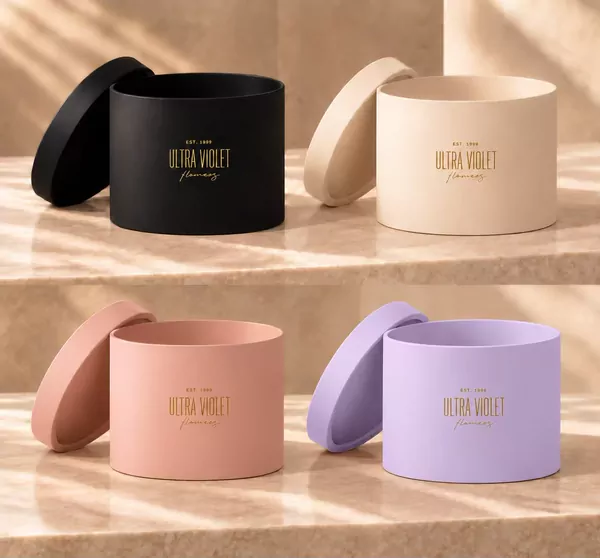
At a glance
- Client industry
- Perfume
- Packaging type
- Cylinder boxes
- Material and wrap
- 2.0 mm greyboard in the base and the lid; 1.5 mm in the collar157 gsm coated paper, soft-touch lamination, foil wordmark on the front face only
- Box structure
- shoulder-neck cylinder, wrapped greyboard, base 92 mm outside height, lid 30 mm tall
Project summaryA fragrance house needed a round box for a 50 ml flacon. It was built as a shoulder-neck cylinder in wrapped greyboard — a 42 mm outside diameter, 38.4 mm inside diameter body with a 30 mm lid, on 2.0 mm base and lid board with a 1.5 mm collar. On a circle the wrap thickness decided the diameter, so the collar is a 1.5 mm disc with a 34 mm aperture set about 40 mm above the base, at 2 mm cap and 3 mm lid clearance.
A round box looks like the easy option until the lid has to close on a circle. This is the project where the wrap thickness, not the bottle, decided the diameter.
The brief arrived as a 50 ml flacon and one sentence: “a round box, like the fragrance used to come in.” That is enough to start, and almost enough to get wrong, because a round box is not a square box with the corners removed. It has one controlling dimension instead of three, and the lid has to close on a circle rather than settle onto four edges.
Client name, artwork and commercial figures are left out. Dimensions, board, wrap, collar construction, clearances and the test that found the first fault are not, because those are the parts that transfer to another bottle.
The flacon being boxed
- Capacity: 50 ml, filled weight 118 g including the cap
- Body: 38 mm diameter, 78 mm tall, with a shoulder that turns in at about 42 mm above the base
- Cap: 32 mm across, 26 mm tall, and heavier than it looks because it is a solid zamac collar over a plastic core
- Finish: clear glass with a printed label that wraps about 200° of the circumference
So: a small, heavy, hard object with a protruding cap and a label that has to stay square to the seam. Every decision below follows from that, and from the fact that the box is sold in a shop and also posted to a customer.
Why a cylinder, and not a square box
The default answer for a 50 ml flacon is a two-piece square box, and it works. It was rejected here for two reasons that are easy to state and easy to underestimate.
The first is dead volume. A square box that holds a 38 mm bottle needs at least 38 × 38 mm of interior, and the four corners hold nothing. On a box this small that is roughly a fifth of the interior volume spent on air, and air is paid for three times: in board, in the carton and in the pallet. A 42 mm cylinder box removes the corners without changing the product.
The second is the shelf. Fragrance is sold in a wall of rectangles, and a cylinder is the cheapest way to stand out of it — no new print budget, no new product, just a different silhouette. That is a marketing reason rather than an engineering one, but it is the reason the project existed, so it belongs in the specification.
The lid has to close on a circle
A square lid is forgiving. It can be a fraction large and still sit square, because the corners locate it. A round lid has no corners to help: it is located by the wall, all the way round, and a fraction of a millimetre either way is visible as a lid that binds on one side or a lid that rattles.
The lid here is shoulder-neck, which means the base carries an inner neck and the lid stops on it rather than sliding all the way down. That does two things. It leaves a visible band of the base below the lid, which gives a small box more presence than its footprint suggests. And it sets the lid square every time, because the neck is a circle the lid cannot argue with.
The fit is the wrap. Each surface carries about 0.16 mm of 157 gsm paper, so roughly 0.32 mm of the clearance is the paper itself, and that number is fixed when the paper is chosen rather than when the tube is cut. The sample was cut about 0.1 mm loose on top of that: a lid that lifts with one hand, not two, and does not rattle when the box is carried by the base.
The collar lets the foot carry the glass
The standard perfume insert is a foam or EVA block with a silhouette cut into it. It grips the bottle along its whole height, which is why lifting the bottle out is a two-handed operation. It also needs wall thickness to hold its own shape, and on a 42 mm box that thickness is paid for in exterior diameter.
This project used a die-cut board disc instead. It is a 1.5 mm greyboard disc that sits about 40 mm above the base panel, with a 34 mm aperture in the middle. The aperture is the whole design, and it has two limits that are both read off the bottle drawing:
- Larger than the cap: 34 mm over a 32 mm cap gives 2 mm of freedom, so the bottle drops in without catching on the thread
- Smaller than the body: 34 mm under a 38 mm body means the shoulder lands on board rather than passing through it
Everything above the shoulder only locates. The foot of the bottle rests on the base panel and carries the load, which is where glass is strongest: thickest section, in compression. A foam block, by contrast, can end up hanging the bottle from its shoulder, and a shoulder hang is what cracks in a drop.
The cap then sits inside the lid. The base is 92 mm tall and the bottle is 78 mm, so 14 mm of the bottle — the cap and part of the neck — stands proud of the base rim. That is deliberate: deepening the base to swallow the whole bottle would add exterior height and make the bottle harder to lift out. The clearance between the top of the cap and the inside face of the lid is 3 mm, which is a static gap plus room for the lid panel to deflect on impact.
Why 2 mm, and not 1.5 mm or 3 mm
The first sample was made in 1.5 mm board because the box is small and the bottle is light. It failed a simple test that is worth repeating: set the filled bottle in, pick the box up by the wall, and watch the base. At 1.5 mm the base bowed enough that the bottle rocked, and a bottle that rocks in a box is a bottle that chips its shoulder.
At 3 mm the wall was stiff enough, but the box gained weight and cost for no further benefit, because a round wall is already working in compression — the shape is doing the work that thickness would do in a square box. At 2 mm the base held a stacked load of twelve boxes without measurable deflection.
There is a second reason to stop at 2 mm: the outside diameter grows with the wall. On a 42 mm box, 0.5 mm of extra wall on each side is a 1 mm larger tube, a larger lid, a larger carton and a slightly larger pallet. On a small box those millimetres are not free.
Structure and specification
| Structure: | shoulder-neck cylinder, wrapped greyboard, base 92 mm outside height, lid 30 mm tall |
|---|---|
| Diameter: | 42 mm outside, 38.4 mm inside, set by the 38 mm bottle plus 2 mm board and the wrap |
| Board: | 2.0 mm greyboard in the base and the lid; 1.5 mm in the collar |
| Wrap: | 157 gsm coated paper, soft-touch lamination, foil wordmark on the front face only |
| Collar: | one die-cut 1.5 mm board disc, 34 mm aperture, sitting about 40 mm above the base panel |
| Clearances: | 2 mm around the cap at the aperture; 3 mm between the cap top and the lid lining |
| Interior: | single-colour print on the inside of the lid, because it is the first surface seen when the lid comes off |
| Quantity: | low thousands, in three colourways that differ only in the wrap and the foil |
What went wrong, and what it cost
Two things, and both were caught at the sample stage rather than in production.
The first was the 1.5 mm base described above. The fix was not a thicker base panel alone — that would have added a step inside the box — but the whole wall going to 2 mm, which kept the interior a clean cylinder. The cost was one extra sample and about a week, because the tube had to be re-cut.
The second was the lid fit. The first lid was cut to the base’s outside diameter plus the nominal paper thickness, and it bound on one side. The reason was not the paper but the seam: a wrapped cylinder is slightly oval at the join, and the lid inherited the oval. The fix was to cut the lid 0.4 mm larger and to rotate the seam of the lid 180° from the seam of the base during assembly, so the two ovals oppose each other rather than add. That is a packing instruction, not a tooling change, and it cost nothing after it was written down.
The drop test was ISTA 1A: ten drops from 760 mm, one on each face, edge and corner of the shipping carton. The carton, not the gift box, is what the parcel network handles, and the gift box inside it showed no chip at the shoulder and no mark on the cap. The test that mattered was less formal: twelve filled boxes stacked for a week in a warm room, then opened. No deformation, and no print odour inside the lid.
What to take from it
- A cylinder has one dimension that matters. The diameter carries the fit, the board and the freight. Settle it before anything else, and count the wrap inside it rather than adding it afterwards.
- The lid fit is the paper. Two surfaces of 157 gsm is about 0.32 mm of clearance, which is most of the tolerance on a small box. Choose the paper before the tube is cut.
- Let the foot carry the glass. A disc collar with an aperture between the cap and the body is stronger and lighter than foam, and it makes the bottle a one-handed lift.
- Check for oval, not just diameter. A wrapped cylinder is never perfectly round at the seam. Opposing the seams during assembly is free; re-cutting a lid is not.
- The carton takes the drop, not the gift box. Test the pair the way it ships, or the result is a number about the wrong object.
Board thickness is specified to ISO 534, the standard method for the thickness, density and specific volume of paper and board, so a millimetre in a specification means the same thing to both sides.
Drop testing follows GB/T 4857.5-1992, the Chinese national vertical-impact method, which is equivalent to ISO 2248:1985.
Production and quality control
Every order is inspected against the approved sample and its signed specification, and that covers six checks: the incoming board and paper, the printing, the finishing, the structure and assembly, the dimensions, and the fit of the insert. The first sample is signed off before a run starts, so print, board calliper, dimensions and insert clearances are agreed on paper before the line runs; the finished box is then checked once more at final pack-out.
Questions this raises
Why a cylinder rather than a square box?
The flacon is 38 mm across. A square box that holds it needs at least 38 × 38 mm of interior, and the four corners are dead volume that still has to be wrapped, printed and shipped. A 42 mm cylinder uses less board and a smaller carton, and it stands apart on a shelf of squares. The saving is not dramatic per box; it is the freight cube that adds up over a run.
How is the lid fit set on a circle?
The lid is a second cylinder whose inside diameter is the base’s outside diameter plus the wrap thickness on both surfaces. On this box the wrap is about 0.16 mm per surface, so roughly 0.32 mm of the clearance is the paper itself. The sample is then cut about 0.1 mm loose, so the lid lifts with one hand without rattling. The fit is fixed when the paper is chosen, which is why the paper is settled before the tube is cut.
Why a disc collar instead of foam?
A foam block grips the bottle along its whole height and makes it a two-handed lift, and it adds exterior volume. A 1.5 mm board disc with a 34 mm aperture over a 38 mm body and a 32 mm cap catches the bottle at the shoulder, while the foot rests on the base panel and carries the load. That is stronger in a drop and lighter in the carton.
Why 2 mm board rather than 1.5 mm or 3 mm?
At 1.5 mm the base bowed when the 118 g filled bottle was set down and the box was picked up by the wall. At 3 mm the wall was stiff enough but the box gained weight and cost for no further gain, because a round wall is already working in compression. At 2 mm the sample held a stacked load of twelve boxes without measurable deflection.
Could the same diameter be reused for a supplement jar?
Yes, provided the jar’s diameter and height fall inside the same tube. Only the lid, the collar and the print change; the tube, the base and the tooling stay. Keeping one diameter across a fragrance line and a body-care line is usually worth more than optimising each box separately, because the carton and the pallet stay common.
Last reviewed . Figures in this article are typical rather than quoted — your written quotation is the document that governs.
Want this looked at for your product?
Send the product dimensions and the quantity. We will tell you which structure suits it and where the constraint on your project is likely to sit.