Greyboard grades explained: thickness, density and cut
Greyboard is specified by three numbers that have to be stated together: thickness in millimetres, grammage in grams per square metre, and density in grams per cubic centimetre. A 1500 g sheet at 0.75 g/cm³ is 2.0 mm thick; the same weight at 0.70 is 2.14 mm, which is a different box.
Greyboard is the board inside a rigid box: the structure that the wrap is applied to, the reason the box keeps its shape when the lid comes off, and the part of the specification buyers most often leave to the supplier. It is bought by thickness, sold by weight, and judged in the hand — three different measurements that do not always agree.
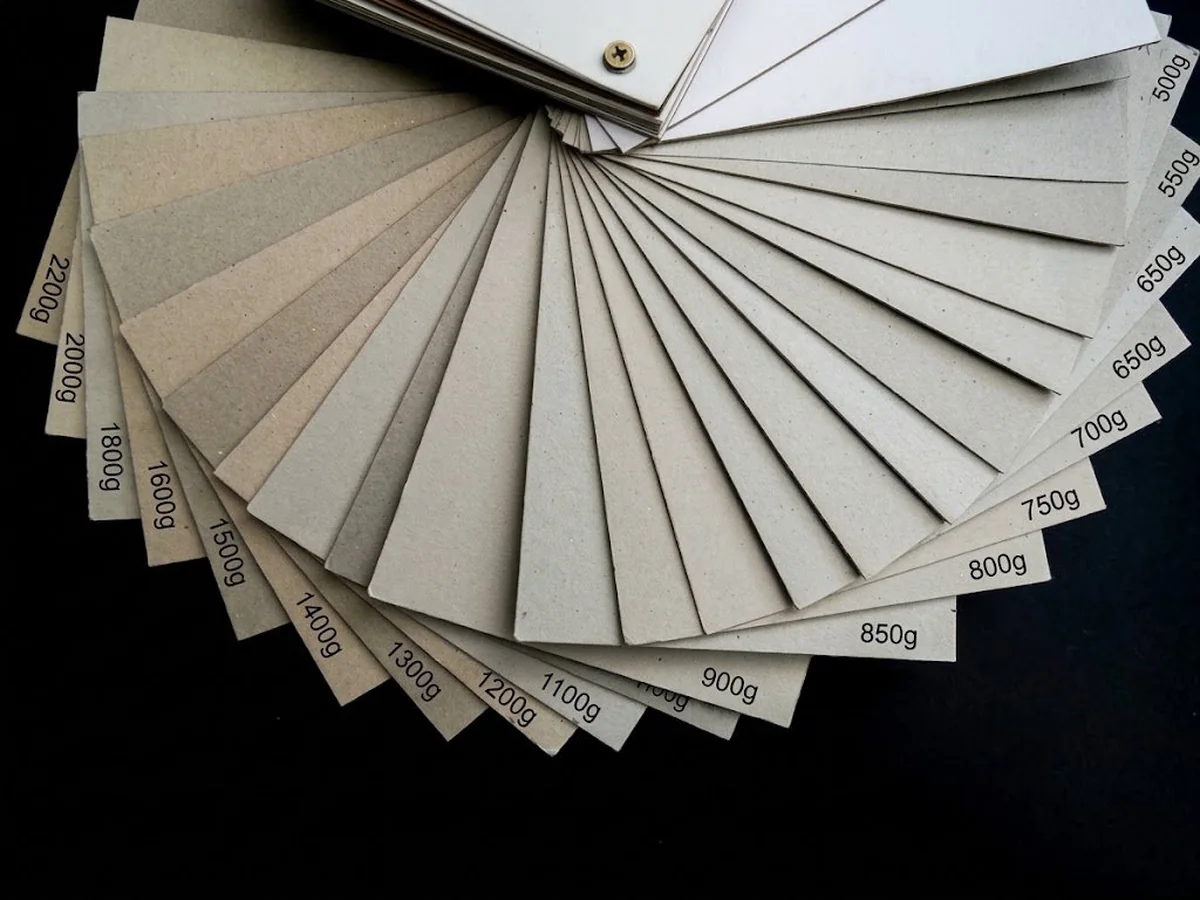
The samples below are the fan our board merchant supplies, from 500 g to 2200 g. It is a useful object to have on the table during a specification meeting, because it makes the first point of this page visible: the labels are weights, the box is drawn in millimetres, and the two are only interchangeable once the density is known.
A grade is three numbers, not a colour
Buyers frequently describe board by appearance — "the light grey one", "the recycled one" — and suppliers answer in the same vocabulary, which is how two orders described identically arrive as different objects. A grade is defined by three things that can be measured:
Thickness, in millimetres, measured with a caliper at several points across the sheet. Grammage, in grams per square metre, which is what the merchant's fan is labelled in and what the invoice is priced on. Density, in grams per cubic centimetre, which is the first two divided by each other and is the number that decides how the finished box feels.
They are related by arithmetic anyone can do. A 1500 g sheet at a density of 0.75 g/cm³ is 2.0 mm thick: 1500 g/m² ÷ 750 g per 1000 cm³ gives 2 cm³ per m², which is 2.0 mm. Change the density to 0.70 and the same 1500 g sheet is 2.14 mm. Same weight, same price per tonne, a different box — and nothing on the delivery note says which one arrived.
Why the fan runs to 2200 g
Rigid boxes are built between roughly 1.0 mm and 3.0 mm. At typical densities that is a grammage range of about 700 g to 2400 g, which is why the fan stops where it does: below 500 g the sheet is folding-carton territory and cannot carry a wrapped corner, and above 2200 g it is a structural board used for furniture panels and heavy cases rather than for a box a customer lifts with one hand.
Above 3.0 mm the arithmetic starts to work against the box. Every additional half millimetre of wall is paid for twice, once at the board merchant and once in the cavity, because the outside dimensions are usually fixed by the product and the shelf. A 20 mm increase in internal length costs 1 mm of wall on each side, so a step from 2.0 mm to 2.5 mm board removes 1 mm of the space the product was going to sit in.
Density is the number that is not on the invoice
Density is set by how tightly the recycled fibre is pressed, and it is the difference between two boards that both measure 2.0 mm on a caliper. It is not usually printed on a quotation, and it is the first thing to ask for when two prices for "2 mm greyboard" differ by more than the freight.
The practical consequences are straightforward. Higher density means more stiffness for the same thickness, so a panel spans further before it bows; it also means a cleaner cut edge, because tightly pressed fibre cuts rather than crumbles. Lower density means a lighter box and a lower price, and a sheet that dents at the corner when the box is dropped on one.
What density does not do is fix a design. A thin high-density sheet is stiffer than a thick low-density one up to a point, but the point is reached quickly on a large panel, and beyond it only thickness helps. The two are chosen together: thickness for the span, density for the handling.
Choosing a board by what the box has to do
The bands below are the working ranges this factory specifies most often. They are set by the filled weight and by the largest unsupported panel, not by how expensive the product is.
| Band | Thickness | Density | Grammage at that density | What it suits |
|---|---|---|---|---|
| Light | 1.0 – 1.5 mm | 0.65 – 0.75 g/cm³ | 650 – 1125 g | Single small items, sampler boxes, jewellery and confectionery |
| Standard | 1.5 – 2.0 mm | 0.70 – 0.80 g/cm³ | 1050 – 1600 g | Fragrance flacons, cosmetic sets, most gift boxes |
| Heavy | 2.0 – 2.5 mm | 0.75 – 0.85 g/cm³ | 1500 – 2125 g | Heavy glass, magnetic closures, multi-piece sets |
| Structural | 2.5 – 3.0 mm | 0.80 – 0.90 g/cm³ | 2000 – 2700 g | Spirit bottles, large presentation boxes, reusable packaging |
Density bands are the ranges this factory works to, not published limits, and a merchant's sheet can sit outside them. The grammage column is arithmetic from the two columns beside it, which is the point: the same box can be specified either way, and the three numbers have to be stated together or they describe nothing.
The cut edge is where a cheap board announces itself
A wrapped box hides its board almost completely. The one place it stays visible is the cut edge — the top of the base wall, the rim of the lid — and that edge is what a buyer sees when the lid comes off in their hand.
On a tightly pressed sheet the cut is square and the fibre is dense enough to hold a clean line. On a loose one the edge crumbles slightly, and the crumbs do two things: they dust the inside of the box, and on a light-coloured wrap they show through as a grey speckle along the rim within a few weeks, because the paper is drawing moisture and the dust migrates into it.
There is a version of this that is not a board fault at all: a blunt die. A die that has cut a few hundred thousand sheets compresses the edge instead of severing it, and the result looks like cheap board on good stock. That is why the edge is inspected against a known sheet rather than judged on its own.
Grain decides which way the wall bends
Greyboard has a direction, set when the sheet is formed: it folds cleanly along the grain and fights the fold across it. A wall whose long edge runs across the grain resists the turn at the corner, and the wrap has to hold it there. It usually does at first — and then, weeks later, the panel cups slightly and the lid starts to catch on one side.
Laying out a die with the grain running the long way of the box costs nothing at the drawing stage and is awkward to change afterwards, because the sheet yield changes. It is one of the few decisions in rigid box manufacture that is free when it is made early and expensive when it is discovered late.
Manufacturing Insight from Metapackink
Two orders, same product, same drawing, board specified as "2.0 mm greyboard". The first boxes came off the line feeling solid; the second felt soft in the same hands, from the same die and the same wrap. Nothing on either delivery note differed.
We cut samples from both batches and measured them. Both were 2.0 mm. One was 0.72 g/cm³ and the other 0.79 — a ten per cent difference in density, which is a visible difference in stiffness once the box is 200 mm across and the lid is carrying its own weight.
The judgement we took from it was not "buy the denser board". It was that thickness is the specification and density is the quality, and a specification that names only one of them is not a specification. We now cut a sample from each delivery, weigh and measure it, and record the density beside the thickness on the inspection sheet. Where a delivery falls outside the band that was agreed, the conversation happens at goods-in rather than at the customer's warehouse.
The cost of that check is a few minutes and one small offcut per delivery. The cost of skipping it is a run of boxes that are dimensionally correct and wrong in the hand, which cannot be sorted after the wrap is on.
What to write into acceptance
For a buyer writing a purchase order, three lines prevent most of this. Name the thickness and the density rather than the thickness alone. State the grammage tolerance the merchant works to, since a delivered sheet at the edge of a wide tolerance is a different box. And say where the grain runs on the die, so a re-order made in a different sheet size does not arrive laid out the other way.
The rest of the structure follows from there: the structures these boards are built into, the thickness question in more detail on board thickness for rigid boxes, and the acceptance checks that catch a bad delivery on the quality control page. The glossary entry for greyboard keeps the definition short, and the rigid box range lists the constructions the board is specified against.
Questions this page gets asked
Is thicker greyboard always better?
No. Thickness buys stiffness across a span, but it also takes space out of the cavity and makes a lid harder to close, because the outside dimensions of a box are usually fixed by the product and the shelf. The right thickness is the one that carries the filled weight over the largest unsupported panel; beyond that, extra millimetres are paid for twice, once at the merchant and once in the space the product no longer has.
How can I tell a good board from a cheap one quickly?
Look at the cut edge rather than the face. A tightly pressed sheet cuts square and holds a clean line; a loose one crumbles slightly and dusts the inside of the box, which then shows through a light wrap as grey speckle. Then flex an offcut: a denser sheet resists the bend and returns more slowly. Both tests take a minute and both are about density, which is the number a quotation usually leaves out.
Our supplier quotes 2 mm board much cheaper than another. What is the difference?
Usually density, sometimes recycled content, and occasionally the accuracy of the calliper reading rather than the board. Two sheets both measuring 2.0 mm can sit at 0.72 and 0.79 g/cm³, which is a visible difference in stiffness on a 200 mm panel. Ask for the density and the grammage beside the thickness, and ask what tolerance the merchant holds on each — a cheap quote at a wide tolerance is not a cheaper box, it is a different one.
Does grain direction really matter on a rigid box?
It matters at the wall, not the panel. Greyboard folds cleanly along the grain and fights the fold across it, so a wall laid out across the grain resists the turn at the corner and relies on the wrap to hold it there. That holds at first and then relaxes: the panel cups slightly over weeks and the lid starts to catch on one side. Laying the die out with the grain along the long edge costs nothing before the die is made and a new die after.
Figures on this page are typical for the construction described, not a quotation. Precision increases once your product dimensions, quantity and destination are known, and the written quotation is the document that governs.
Board thickness is specified to ISO 534, the standard method for the thickness, density and specific volume of paper and board, so a millimetre in a specification means the same thing to both sides.
Drop testing follows GB/T 4857.5-1992, the Chinese national vertical-impact method, which is equivalent to ISO 2248:1985.
Send the dimensions and get a structure back
Product dimensions, quantity and where it ships. That is enough for us to propose a structure and an indicative price.